
With my Peregrination year winding down, (and yes, I know that I’m over 2 years behind with my “Blog”), and not having plans to do any major trips, I don’t have expectations of tallying any more “Lifers” or “Year Birds” before New Year’s. If I was shooting for a “Big Year”, I would be jetting all over the country, desperately trying to add just one more bird to the list. There is a Red-footed Booby and a Garganey in California, a La Sagra’s Flycatcher in the Florida Everglades, an Antillean Palm-Swift in the Florida Keys, and a Fork-tailed Flycatcher in Texas. All would be great birds and add to my year’s species list.
But, I’ve done well on my initial goal of seeing “at least 75” new-to-me species this year. And, I’m in contention for being among the top-ten birders in North America for the number of species seen this year. Anything new here in south Puget Sound will be “gravy”. The local Christmas Bird Counts found some “good” birds, including a King Eider in Bellingham, both Slaty-backed and Lesser Black-backed Gulls in Walla Walla, Jen DeSelle’s find of an Eastern Phoebe in Olympia! But, these are species I’d seen elsewhere over the year, so I’m not “chasing” them.

With that in mind, on the morning of the 18th, I went out to Nisqually Refuge with the “Wednesday Bird Walk” group. We always hope to find a “good bird” on the walk, and we have been graced this season with a wintering Red-shouldered Hawk.

This species was quite rare in Washington 40 years ago, but the species has been expanding north from its stronghold in California and the Washington Bird Records Committee removed them from their list of Review Species in 2008.
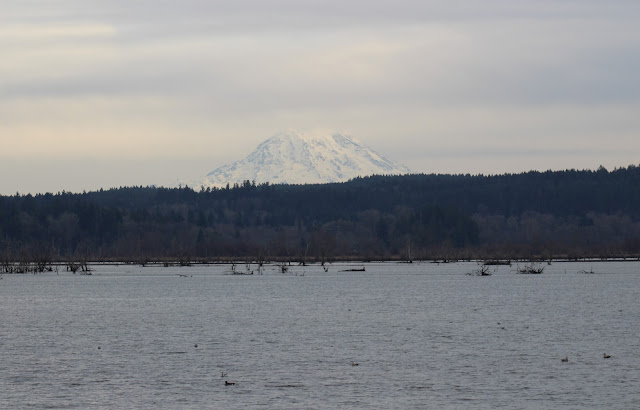
It was a pleasant December day for us, in that it was fairly calm and not raining. One enjoys the little things in the Pacific Northwest winters, like being dry. And good friends. And good birds.

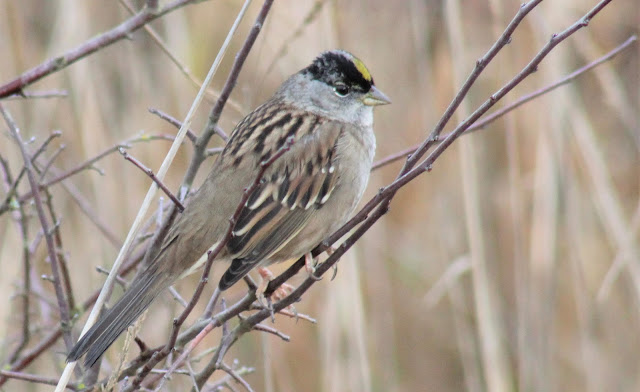
We took our usual spin around the old orchard and out past the Twin Barns to the north dike and estuary to catch the 11 a.m. high tide, which allows the ‘deep water’ birds to come closer to where the birders can see them. On the way out, we came across a single White-crowned Sparrow which, from its ‘straw-colored’ bill, we presumed to be of the Gambel’s subspecies. The Puget Sound subspecies has a more-yellow bill.

The high water did not disappoint, and
we were able to sort through the myriad of gulls. The most common “large, pink-footed gull” in
the area is the hybrid “Olympic” Gull which is a crossbreed Glaucous-winged and
Western Gull combination.

And, it provides an opportunity for the birders to get good comparisons of species that are somewhat similar. The Ring-billed Gull on the left, and the Mew Gull on the right are both small Larus species. The Ring-bill has a more robust bill - with a black ‘ring’ behind the tip - and is a little larger than the Mew Gull, which has a more delicate bill. This bird’s bill is slightly ‘smudged’, but doesn’t have a distinct black band.

One of these is not a sea gull . . .

As we went out onto the estuary boardwalk, we had good views of a Great Blue Heron, who had a great view of the Birders. The Nisqually intertidal zone provides absolutely great foraging habitat for herons, especially in the restored estuary area.

With the +15-foot high water, we saw a Spotted Sandpiper on ‘our’ side of the McAllister Creek estuary. We mostly see them on the west side of the channel, so it’s nice to see them here, closer than 1/8 of a mile away.

The Refuge closes the last 700 feet of the estuary boardwalk during the State waterfowl hunting season, which runs into late January. Some of the visitors question the reason for this, but it’s merely a matter of safety. The Refuge built the boardwalk clear out to the boundary of the Federal land with that of the State Wildlife Area. The State Dept. of Fish and Wildlife allows duck hunting on their property, so it makes sense to separate the user groups; no one wants to have steel bird shot raining down on them from a nearby hunter shooting at a wigeon. And, it’s only for a few months.

In all, we saw 73 species of birds, as well as several native and non-native mammals. The group meets at 8 a.m. every Wednesday at the Visitors’ Center of the Refuge, and welcomes birders of all and any expertise to join them.

On Thursday, I ran out to the Eagles Pride Golf Course on Joint Base Lewis-McChord, where biologist David Wienecke and Denis DeSilvis host a bird walk on the Third Thursday of every month. This group meets at 8 a.m. at the Driving Range Tee, and walks a 3¼ mile route through the fir and maple woods and along the various courses.

Today, we saw 32 species; the most unusual for this walk was a nice female Townsend’s Warbler, which shouldn’t be uncommon here in the winter, but we rarely see one on this walk. One would think with all of the coniferous habitat on the course, we would see them more regularly.

One natural history item that always catches one’s attention here in the western Washington woods is the nest of the western thatch ant (Formica obscuripes). In spite of the propaganda put out by the “Pest Control” businesses who will happily take your money to spray poison on them, these ants are beneficial to your woods or your residential yard. These black-and-red ants maintain aphid colonies so as to harvest the aphid’s “honeydew”, but also prey on all sorts of other detrimental insects. This ant mound has a hole in its side, caused by a Northern Flicker excavating for its own lunch of ant eggs and pupae.

Once again, we lucked out with the weather today: The forecast was for lots of rain, but none of it really started until about 20 minutes after we finished the walk. The birds were a bit quiet at the beginning of the walk, but we ended up seeing 31 species. The highlight of the walk was the group of eight Northern Flickers and the Townsend’s Warbler in the willows.


