Showing posts with label Texas. Show all posts

Saturday, October 9, 2021

November 18, 2019 - Underground New Mexico

I woke at 3:30 to a fairly clear 47º morning, and as I couldn’t get back to sleep, got up, ate breakfast, and got on the road by daybreak.  As one drives through west Texas, there’s no doubt that Oil is the basis of the economy here.


I don’t know how much natural gas is burned off (wasted?) here, but almost every facility is sporting a perpetual flame.

I drove on into New Mexico, with an eye to visit part of America that I’d never seen before.
Deep beneath the Chihuahuan Desert in southern New Mexico is a labyrinth of more than 300 limestone caves, carved over 250 million years ago, and since I was in the vicinity, it was time to visit the Carlsbad Caverns National Park.

At 9 a.m., I pulled into the Caverns, getting in “free” with my ”America the Beautiful - The National Parks and Federal Recreational Lands Senior Pass”, which costs $20 a year or $80 for a ‘lifetime’.

I watched the 15-minute introductory video, and then embarked on the self-guided tour, having rented the self-tour guide for $5.  Although this Park gets around a half-million tourists visiting every year, there were few enough on this November morning to allow for a pleasant visit.

On the walk to the natural entrance, there were several interpretive signs for the visitors, and I always enjoy learning a little about the local natural history.

The Algerita (Mahonia trifoliolata) was used by the indigenous people for food (berries), medicine (a concoction used to treat sores), and a yellow dye was made from the roots.

Another sign noted the seeds of the Catclaw Acacia (A. greggii) were ground into a meal called pinole, and made into cakes or eaten as a mush.  The native bees gather nectar when its yellow flowers bloom.  I enjoy seeing the various species of acacia, as I remember “A Sprig of Acacia” that features in an old story known to those with eyes to see and ears to hear.

At the entrance to the cave, there’s a warning sign about Radon.  Radon is a radioactive, colorless, odorless, tasteless noble gas that is reported to be carcinogenic.  There seems to be quite an industry built up around testing homes for radon, costing about $75-200.  For the same price, you can buy your own radon detector . . .

Thousands of Mexican freetail bats use the cave, and the interpretive signs happily let us know about them.  This being November, most of the Caverns’ bats have decided to winter south into Mexico.  The best time to see them might be in August or September, when daybreak or sunset flights are said to be pretty neat!

The entrance to the cave is paved and easy to traverse.

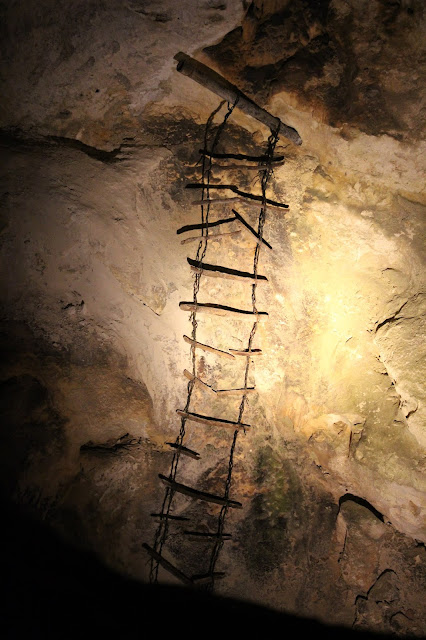
The old entrance was certainly more challenging, and there are remnants of the old ladders and staircases in the caverns.  There are still wooden stairs that originally took people down a different way until the “iceberg rock” detached and fell crushing the stairs and necessitating a new entrance.

I presume that the Park Service leaves the old stairs, etc. in situ because they now have “historical significance”.


Carlsbad Cavern includes a large cave chamber, the Big Room, a natural limestone chamber which is almost 4,000 feet (1,220 m) long, 625 feet (190 m) wide, and 255 feet (78 m) high at the highest point.  It is said to be the third largest chamber in North America and the seventh largest in the world.  There are certainly lots of things to see here.

I did not find out what caused the green layer on this speleothem column.  In some caves there are impurities of glauconite, an iron potassium phyllosilicate with a green colour.  Or, because the Caverns are subtly lighted for the tourists, it could well be caused by algae growth on the calcite.


Whether you are a Cave Junkie, or never give karst caves a second thought, you can’t help but be amazed at the beauty of the formations.

Of course, people have given cute names to many of the dripstones and flowstones.  This one’s the “Whale’s Mouth”, ostensibly because the folds in the rock look like baleen.

A block of solid gypsum is impressive for those of us who got decent grades in our Geology classes.

The water in the cave is crystal clear.  I attempted a picture of some pools with neat little rimstone dams, but between my camera and my ‘droid phone being challenged by the low lighting, you’ll just have to visit here yourself to see those.

I did not take a flashlight, but used the light on my cell phone here and there to view some of the features; I think a really bright light would have detracted from the (my) experience.  It is probably a good idea to take a light jacket, especially in the summer when the difference between the surface heat and the cool underground would be pretty great.  The temperature of the Big Room of Carlsbad Cavern, at a depth of 750 feet (about 230 meters) below the surface, is 56°F (13°C).

Dropping off the audio guide, I left the Caverns and took the Desert Drive, seeing a few Scaled Quail.  I tooled across the Guadalupe and Sacramento Mountains to Cloudcroft, checking into the Summit Inn among the pines and firs in the Lincoln Natl. Forest.

I suppered with a green chili cheeseburger and a couple pints at Dave’s Café.  They seem to run a friendly, local place that made me feel at home.  I’d eat here again.

Carlsbad Caverns Desert Drive eBird Checklist is Here


Thursday, September 30, 2021

November 17, 2019 - Remember the Alamo

I woke to a clear 47º morning, ate breakfast at the motel, checked out then went out to the Mitchell Lake Audubon Center, where I was greeted by an Angel!  Angel Poe, the Center’s Education Specialist, who let me know about the trails and what birds were being seen in the area.  I happily paid the $5 admission fee before walking the loop trail around Bird Pond.

White-crowned Sparrow
I flushed a covey of Bobwhite quail, but couldn’t get a camera shot of the little speedsters.  Returning to the Center, I drove around a couple of the polders, looking for a Solitary Sandpiper, a species which I have somehow missed during this year’s journeys.  I “dipped” on the search, but did get an eye on a Sora, which - of course - flew and disappeared in the vegetation before I could grab the camera.
Orb-web spider
The spiders don’t move as fast.  The black-and-yellow argiope spider (Argiope aurantia) is quite attractive and one of the more conspicuous species of Texan orb weaving spiders.
Prickly Pear
Since I’m out of my ‘back yard’, I’m constantly intrigued by the vegetation of Texas, which is so different to that of my Pacific Northwest home.  It’s always a kick to check out the plant life while looking for birds.
Air Plant
As in much of the South, the “ball moss” is the “air plant” on the trees here.  This is Tillandsia recurvata, a member of the Bromeliad family.  The species is an epiphyte, not a parasite.  It draws no nutrition from the tree, just uses it as a place to live.  Southerners are used to another Bromeliad in this genus: Spanish Moss (T. usneoides).  Most of us “northerners” are at least familiar with another Bromeliad: The Pineapple!
Retama

The Retama (Parkinsonia aculeata) is sometimes called by the common name Jerusalem Thorn, which does not refer to the Middle Eastern city but is rather a corruption of the Spanish and Portuguese word girasol, meaning "turning toward the sun."

Rain Sage
I thought I’d found a ‘feral’ plant of garden sage, but discovered that it was instead the Texas sage or Rain Sage (Leucophyllum frutescens).  Cenizo “ashen” is a Spanish reference to the silvery leaf color.   It looks very much like the commercial plant, but is in a different genus, and can be used to make a tea.

Huisache
I am amazed at the number of species of Acacia - here in the U.S. and world-wide - and was puzzling over this one.  It is “Sweet Acacia”, more commonly known in Texas as Huisache.  The plant used to be in the Genus Acacia but recent taxonomic investigations refer to it as Vachellia farnesiana.
Lotebush

This shrub is not dead; its leaves are deciduous and absent for much of the year, leaving the shrub a naked thicket of gray twigs coated in waxy whitish hairs. The ends of the twigs taper into sharp-tipped thorns.  It’s called Lotebush (Ziziphus obtusifolia).

Christmas Cholla
The Christmas cholla (Cylindropuntia leptocaulis) is a cactus, different to the Schlumbergera “Christmas cactus” sold in the stores.  Also known as Tasajillo, it has thin, brittle stems like a pencil, and colorful winter fruit like red ornaments, provides nesting sites for Cactus Wrens, and its fruit is a good food source for birds and other small animals.
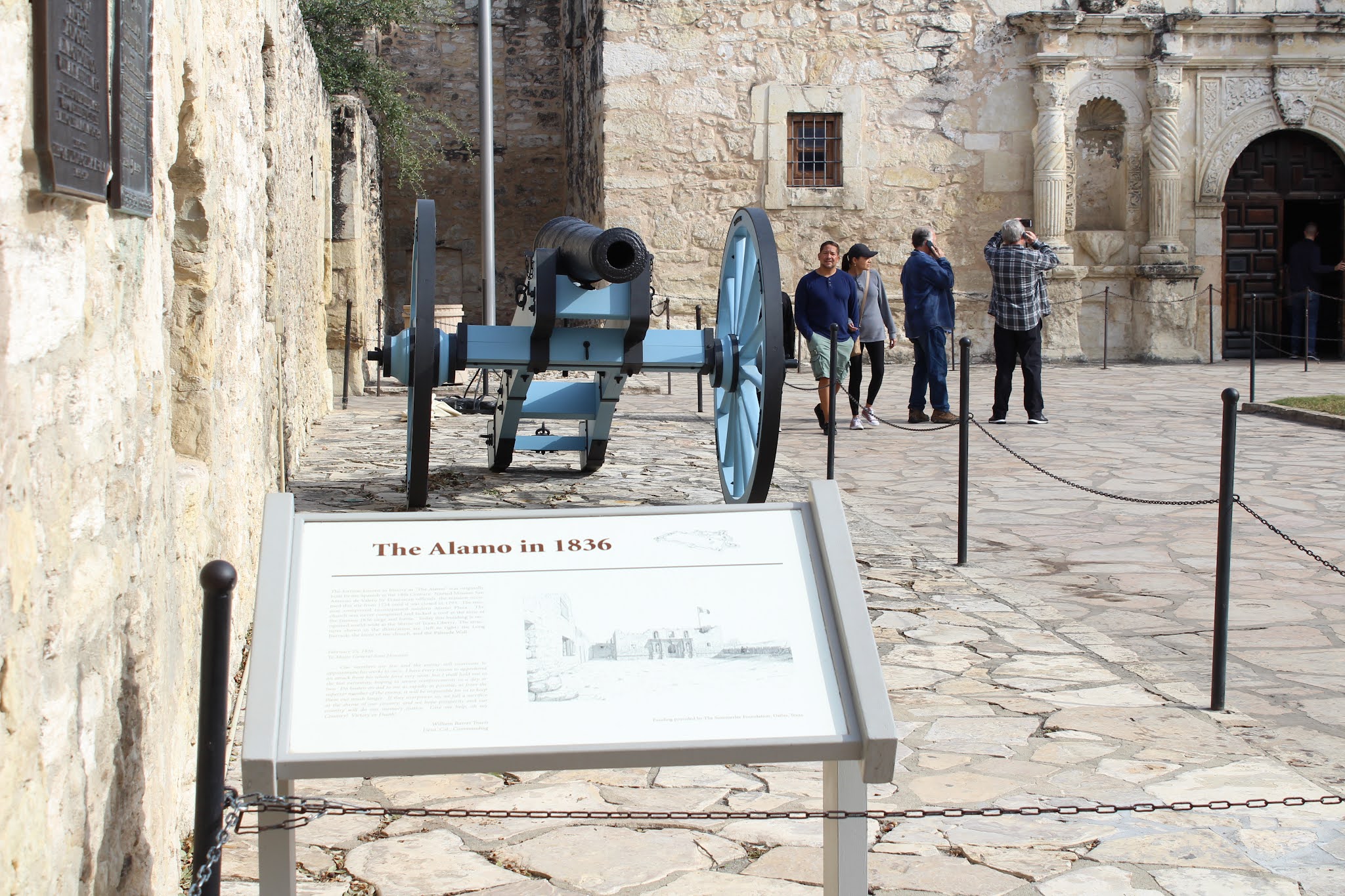
Alamo Cannon

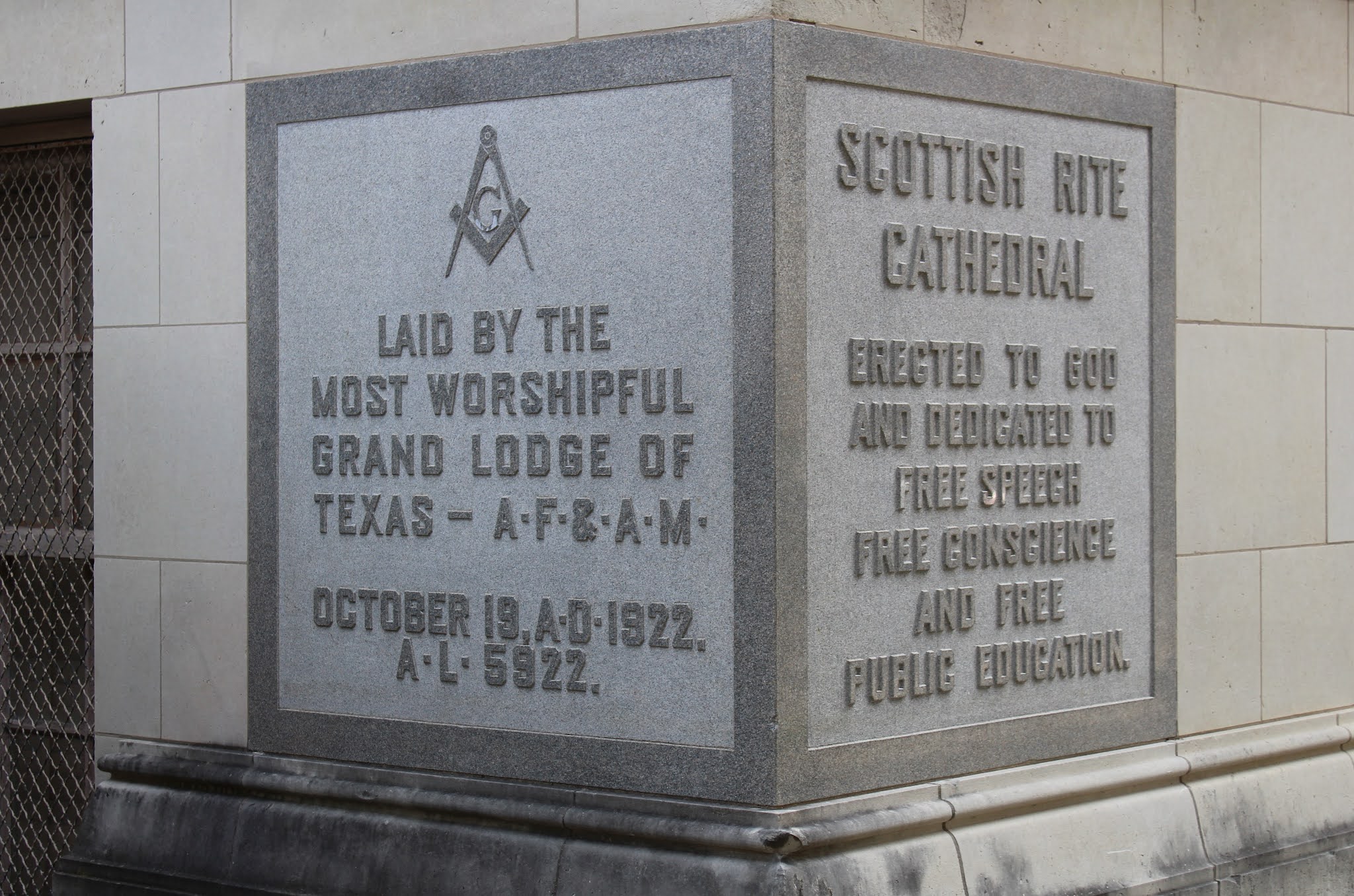
Afterwards, I drove along the polders and ponds until early afternoon & headed into town.  I had grown up reading the story of the Alamo, although I never had a ‘coonskin cap.  Since I was in town, I determined to visit and learn a bit about it.  I parked across from the Scottish Rite Library and Museum, which - since it was a Sunday - was not open when I stopped.  Next time I’m in town, I’d love to visit the museum.

The Alamo
The famous battle of the Alamo in San Antonio de Béxar took place in 1836, during the fight of the Texians and Tejanos to divest themselves of Mexican rule.  The story of the battle has suffered from the hubris and mythology of the Texans’ legends spread by many of the movie and television adaptations, but - then again - Truth often diverges from Fact.  Especially in Tejas.  No?
Alamo Restoration Work

The site was being visited by quite a crowd, and the guided tours were full for the morning, so I opted to walk around the grounds by myself.  Much of the Alamo’s structures, being built of limestone or adobe brick over 200 years ago, have suffered from the vicissitudes of the seasons, as well as misguided attempts to repair and/or protect the buildings.  The renovations are on-going.

Alamo Archaeology

There are also archaeological investigations on and near the grounds.  One should keep in mind that the Alamo Square is but a small part of the battle area, and most of the site has been converted into the businesses and homes of urban San Antonio.

Stephen Fuller Austin listening to the Docent

There are many monuments and statues of the historic figures from the Alamo.  I listened in on several of the discussions by the docents and was impressed that they didn’t just play up the “John Wayne movie” version of the War and the battle, but gave consideration to the “real” historical background.

Seguín was a Democrat and Republic of Texas Senator (1837–1840)

Juan Nepomuceno Seguín was a Tejano revolutionary and politician who helped establish the independence of Texas.  Seguín, convinced that Spanish-Mexican unrest and Mexican governmental interference were contributing to economic upheaval in Texas, sided with Steven Austin, became active in local politics, was elected alderman in San Antonio in 1829 and became that city’s mayor in 1833.  Anglo-Tejano politics resulted in him moving to Mexico and fighting on Mexico’s side during the War of 1846-48.

"King Of The Wild Frontier"

“Davy” Crockett was a frontiersman, soldier, politician, and congressman from Tennessee.  After losing his re-election bid in 1834, he famously told his constituents “… they might go to hell, and I will go to Texas.”  He did, and ended up at the Alamo.

By 1 p.m., it was time for me to get on the highway, and work my way toward home.  I headed west on I-10, ending up in Fort Stockton, where I checked into the La Quinta Inn, and had a pretty darned good supper of ribeye with chilis, rice & beans at Pepito’s Café.

Mitchell Lake Audubon Center Bird Pond Trail eBird Checklist is Here 

Mitchell Lake Audubon Center eBird Polder Drive Checklist is Here  


Sunday, April 18, 2021

November 12-16, 2019 - Texas Gulf Coast Birding

November 12 - Last Try at Sabal Palm

I had a pretty good stay in the Brownsville Best Western.  The suite was clean and spacious.  The property provided hot breakfast with scrambled eggs (sometimes with chorizo), meat (bacon or sausage patties), and rotating biscuit & gravy or flour tortilla, and salsa.  The fridge was well-stocked with yogurts, fruit.  And the Texas-shaped Waffle machine was onmplemented with syrup or “HONEY” (I love honey! ...)  The Internet worked pretty well.

I slept in a bit this morning, having wakened in the wee hours for several days to go on field trips during the Rio Grande Valley Birding Festival.  I knocked out a blog post for August 11th, which at the time made me feel pretty punk - I was three whole months behind in my blogging!  I’m now a year-and-four-months behind.  I don’t know if that makes me feel any better or worse, but birding and the rest of my life somehow took precedence over blogging.  Not sorry . . .


I figured that I would make one last attempt to find the reported Groove-billed Ani at the Sabal Palm Sanctuary, so checked out of the motel and arrived at the sanctuary just at 11 a.m.  The weather had blown in, so that it was raining, windy and 38-40° F.  Even the birds aren't this crazy . . . the rain abated around 1 p.m., but the wind kept blowing at 5-15 knots from the north. Made it difficult to hear and the birds kept pretty much to cover.  I, being ever the optimistic birder, spent 5 hours there before I finally bagged it.  Even with the cool weather, the Green Anole lizards were attempting to warm themselves along the trails.  These lizards can change their color from green to brown.

It was an experience to be in this habitat, for an old Pacific Northwest boy.  Besides the “exotic” vegetation and birds, there’s Mexico right across the River!  I now live not too far south of the Canadian border, but somehow it’s different to gaze into our Neighbour to the South.

I never did see an Ani, but did have great views of a Bobcat near the Rabb House.  What was neat was that a Great Horned Owl showed itself in the palms.  This bird had very reddish-brown plumage, which I thought quite handsome.  The Great-Horneds where I’m from in western Washington tend to be dark brown - to blend in with the dank Pacific Northwest forests . . .

Leaving the Rio Grande Valley, I headed east, making it as far as the Rodeway Inn in Kingsville and checked in for the night, then ate supper at La Hacienda restaurant.  Even at the ‘chains’, I’ve not had any bad Mexican food in this State.

November 13 - Oso Bay

Today would have been Dad’s 97th Birthday.  I still come up with questions or thoughts and think, “I need to call Dad…” then realize that I’ve been an orphan for the last 9 years.

I slept in until nearly 7 a.m., and packed to leave Kingsville and move on toward Liberty.  The Rodeway was not quite the quality of the BW Casa Villa, but was clean, and had fairly good lighting (I like light!).  I had gone on the eBird website to find a spot near Corpus Christi where Groove-billed Anis had been seen within the last week, so drove to the Oso Bay Wetlands Preserve and walked the trail loops.

Much of the 162-acre site is covered with mesquite, which the preserve is ‘managing’ with some grassy openings.  They have two miles of walking trails and have also built a few platforms overlooking the bay.

A Gulf Coast Clapper Rail put on a bit of a show in the brackish marsh.  I never did find the Anis, but enjoyed the walk in the cool afternoon breezes, until I realized that it was 3 p.m. and I still had over a four hour drive to Dayton to have supper with my favorite Daughter, Becca.

I pretty much drove straight through, enduring the traffic in Houston, and made it to the Dayton Best Western a bit before 8 p.m.  Rebecca texted me to meet her at the Los Compadres restaurant for supper, where they had Menudo on the menu!  I had that and a guacamole salad for supper, and Becca had grilled vegetables on lettuce (and half of my guac salad).  I gave her a Birthday present of the Plants of the Trans-Pecos book that I’d ‘won’ in the Rio Grande Valley Birding Festival’s Silent Auction, as well as the ticket to the Ranch Hand Weekend Country Concert featuring Mark Chesnutt, which is scheduled for this coming November 23rd.

November 14 - Anahuac

I slept in until 5:30 and drank some coffee to wake up, then went down to the breakfast nook of the Best Western motel in Dayton.  I had little incentive to rush out to do any birding, since it was a rainy 44º morning, so worked a bit on the ‘way-behind blog posts.  Mid-morning, I decided to do some birding south of town at Anahuac National Wildlife Refuge.

En route, I stopped at a couple places along County Road 118, hoping to pull out some odd sparrows or blackbirds from the flocks, but found nothing new.   I also stopped at the Cedar Hill Park near Wallisville.  This is a nice little picnic area, but I had the place to myself so walked around a bit.  The lake was pretty high, but there were lots of White Pelicans on the water.


I arrived at the Refuge and found the water was pretty high.  But, the Auto Loop was open, so I drove it and enjoyed seeing the waterbirds.


It’s always a thrill for a ‘northerner’ to see the Whistling Ducks.  When I began birding, back in the 70s, these were called “Tree Ducks”.

And, you can’t drive around Anahuac without seeing feral hog tracks, and often can see the animals themselves.  Amazingly, a month after I was here, a local woman was killed by hogs in December 2019!

November 15 - Anahuac to High Island to Galveston

I slept in until about 6:30, and worked on a Blog post for August 12-14th, (only three months behind at that point) then checked out and headed in to Liberty to the Teachers Credit Union to get some cash, only to find out that they are not part of the shared branching system.  So, I met Becca at Jax’ Hamburgers for lunch.  She had a salad with grilled vegetables and I had tomato soup and a toasted cheese sandwich for $16 total.

She had to return to work at her NRCS job.  I, Taking my leave, worked my way south toward the Gulf, checking a number of rice fields and hoping to hear either Yellow or Black Rails, but was unsuccessful.  I stopped at High Island to walk through the “Boy Scouts Woods” preserve managed by Houston Audubon, but it was really quiet for birds.

This Chipping Sparrow is easily identified by its grey rump patch.

There are always Fire Ants in the South, an invasive, non-native, nasty, biting, stinging insect.  What would be a gopher or mole mound back home in Washington State might be stepped on.  Not here: You need to watch where you walk so you don't stir up these little heathens!

I did see this cool-looking nuptial scorpionfly there.  “The Order Mecoptera has special importance in the evolution of the insects.  Two of the most important insect orders, Lepidoptera (butterflies and moths) and Diptera (true flies), along with Trichoptera (caddisflies), probably evolved from ancestors belonging to, or strictly related to, the Mecoptera.  Evidence includes anatomical and biochemical similarities as well as transitional fossils, such as Permotanyderus and Choristotanyderus, which lie between the Mecoptera and Diptera.  The group was once much more widespread and diverse than it is now, with four suborders during the Mesozoic.”  This is apparently a female, as the males have enlarged genitals that look similar to the stingers of scorpions.

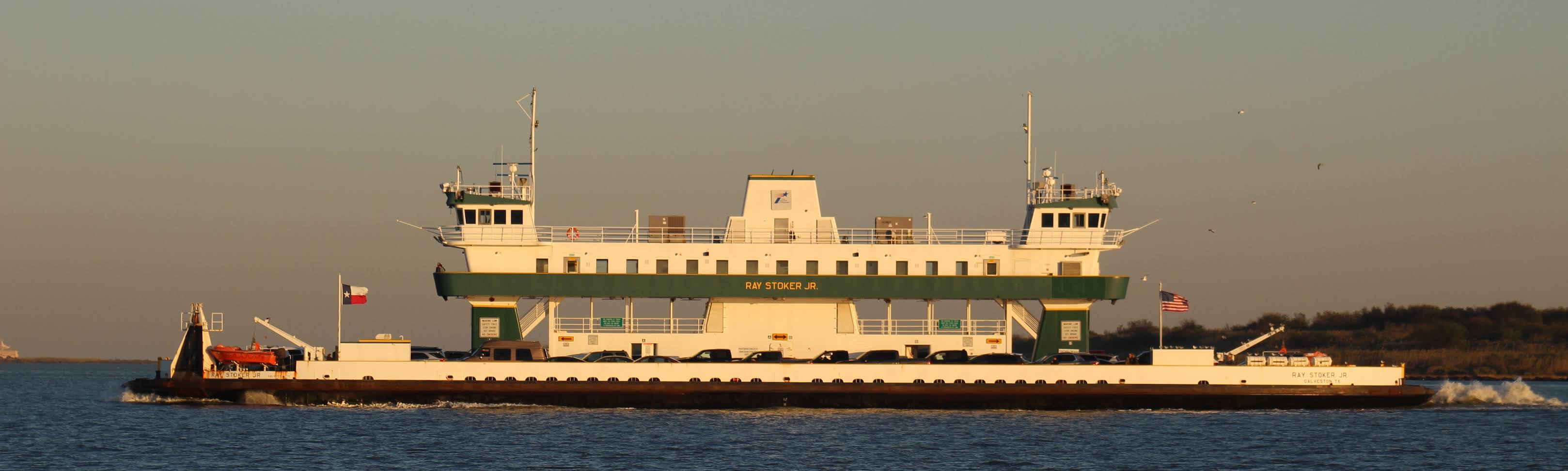
Continuing west, I took the Galveston-Bolivar Ferry, and stopped at East Beach to take in the sunset and hope for a Lesser Black-backed Gull, again unsuccessfully.  So, I gave up and made it as far as Texas City, checking into the Best Western for the night.


November 16 - Galveston Island

The day dawned clear and 42º F.  After breakfast at the motel, I checked out some cash from the Associated Credit Union of Texas ATM (who are partners in the shared branch system of Credit Unions), then checked out and drove back to Galveston Island, where a Groove-billed Ani had been seen within the week at the Artist Boat Coastal Heritage Preserve.

This is a 690-acre conservation area on West Galveston Island, and the goal of the organization is to preserve and restore 1,400 contiguous acres from bay-to-beach.  These kind people allow public access.


I walked the prairie for an hour, then walked up the Settegast Road, which is an eBird “Hotspot” in its own right.  While the Artist Boat folks allow access to their property, this is - after all - Texas.  The Preserve’s neighbors aren’t quite as accommodating.  In Texas, the Purple Paint Law means 'No Trespassing'. Landowners can mark a tree or fence post along the edge of their property to keep those involved in hunting or hiking away.  To act as a ‘No Trespassing’ sign, purple paint markings in Texas “must be: vertical, at least 8 inches long, at least 1 inch wide.  The bottom of the mark should be between 3-5 feet above the ground.  Markings can be no more than 100 feet apart in timberland.  Markings can be no more than 1,000 feet apart on open land, and they must be in a place visible by those approaching the property.”  Trespassing on marked property in can be a Class B or C misdemeanor in Texas, punishable by up to a $2,000 fine or up to 180 days in jail.

But, there was good birding along the quarter-mile road, with nice views of waterbirds.


Coming back toward the car, I was greeted with a cheery “good morning” by bird-savvy resident Alice Ann O'Donell, who let me know that Brown Boobies have been seen recently at the end of 8 Mile Road, so I went over there but could not scope them out.  I did find a Lesser Black-backed Gull perched on a utility pole, for my 600th Species of the year.

Finally, I called it a day and drove away from the Gulf, heading north on I-45 to Highway 6 and across to Sugarland and then west on I-10 to San Antonio.  I stopped at the Costco to have my tires rotated, as I was ‘way overdue, and ate a soup and salad at Jordan’s Deli.  The sun was setting, so I drove down to the Sure Stay and checked in for the night.

November 16

Artist Boat Coastal Heritage Preserve eBird checklist is Here

Settegast Road eBird checklist is Here  

8 Mile/Sportsman's Road eBird Checklist is Here

November 15

Galveston East Beach eBird checklist is Here

Bolivar-Galveston Ferry eBird checklist is Here

High Island eBird checklist is Here

Anahuac NWR Skillern Tract eBird checklist is Here  
County Road 118 eBird Checklist is Here

November 14

Anahuac NWR Willows Trail eBird Checklist is Here

Anahuac NWR Auto Loop eBird Checklist is Here

Wallisville Lake eBird Checklist is Here

County Road 118 eBird Checklist Stop No. 2 is Here

County Road 118 eBird Checklist Stop No. 1 is Here

November 13

Oso Bay Wetlands eBird checklist is Here  

November 12

Sabal Palm Sanctuary eBird checklist is Here