Showing posts with label Short-eared Owl. Show all posts

Sunday, May 26, 2019

May 9 - Little Bighorn

I woke up to a clear & frosty 28ยบ morning, and headed down the road toward Judith Gap.  Not far out of town, there was a nice Short-eared Owl perched alongside the road.
Here's Looking at You
The eBird program noted that Sprague’s Pipits had been seen along Old Gap Road, southwest of Judith Gap, and I'd never before seen this species.  So, I pulled off the highway into several inches of snow from this morning's weather.
Long-billed Curlews waiting for the day to warm up
The white expanse was full of birds, and many of them came up to the edge of the fields and onto the road, where the snow and hoarfrost was beginning to melt.
Chestnut-collared Longspur
It's cold, but sunny.  Let's Sing!!
The Vesper Sparrows were also in a singing mood.
Many Horned Larks.  This one's taking a break from "larking"
McCown's Longspur
I drove slowly along the roads, searching for the Pipits, but none were seen.  Along Old Gap Road, the window was down (yes, it was cold) and I finally heard the distinctive Flight Song of the Sprague’s Pipit.  Try as I might, I could not see the bird (birds?) out across the snowy fields.  Just the Longspurs and Horned Larks.  I would prefer seeing a “Life Bird” rather than merely hearing it, but I’m not proud, and chalked up the Sprague’s Pipit as No. 601.
Horned Lark showing his horns
Since I was in that corner of America, I decided to drive through the Crow Agency to visit the Little Bighorn Battlefield National Monument.  I’d read the histories of the “Great Sioux War” for years, with John G. Neihardt’s book Black Elk Speaks being one of the earliest I can remember.  So, given the opportunity to walk the hills and see the site provided me with a clearer understanding of how the events transpired.  The National Park Service here does a great job of education and interpretation.

I began my visit by walking through the National Cemetery here.  This Cemetery was established by General William Tecumseh Sherman in 1879, who issued General Order No. 78 designating part of the Custer Battlefield as a national cemetery.
Those who know me are aware that I am a Freemason, and I was surprised to find one headstone here in the cemetery carved with the Square and Compasses.  The stone is that of First Sergeant James Brown.  Brown's gravestone has the Freemason symbol on it, indicating that he, like many other Buffalo Soldiers, was a member of a Prince Hall Masonic Lodge. One of the first black military masonic lodges was established near Fort Davis, Texas, in 1883 and was called the Baldwin Lodge, likely after Troop I's commander, Captain Theodore Baldwin. Since it was a military lodge, its location moved with the soldiers, and in 1887 Baldwin Lodge #16 was at Fort Verde, AZ, and in 1889 it moved to Fort Apache, AZ.  Brown held the military ranks of Sergeant and First Sergeant during his long military career, which was cut short when he froze to death between Havre and Fort Assinniboine, Montana.
Many of the headstones honor Unknown soldiers.
Others indicate that the soldiers passed due to the many accidents and diseases of the day.  These stones are among those that were translocated in 1905 from burials in the Dakota Territory:
Cpl. Francis Hubner Drowned in 1870


Cpl. Charles H. Raymond was struck by lightning in 1878
First Sgt. Aquilia Coonrad died while in charge of a Quartermaster’s Escort in 1884
He Was a Medal of Honor Recipient
Another stone honors Captain Wm. Logan, who was killed at Big Hole during the Army’s pursuit of the Nez Perce.
I walked out onto the Little Bighorn Battlefield itself, and down the “Deep Ravine” where a number of stones honor those Native Americans who fought to maintain their freedom and way of life.

Boston Custer was the youngest brother of the “famous” Lt. Col. George A. Custer.  The stone marks the approximate location where he fell, as his remains were re-interred to Michigan.
Most of the markers merely state “US Soldier 7th Cavalry”, as their remains were buried together in the mass grave atop the hill.
Beyond “Custer’s Last Stand”, the Monument includes a section of the route that Major Marcus Reno’s troops engaged the Lakota and Cheyenne.
From several of the pullouts, one can see the “Greasy Grass” valley, and imagine how it must have looked with a city of 10,000 people on that June morning.
Walking and driving across this prairie made the stories I’ve read come to life.  It is somewhat emotional for me to visit a place where so many people died, although something inside me ‘needed’ to come here.
I left the Monument and continued driving as far as Broadus, Montana this afternoon, checking into the Sagebrush Inn for $80.  Not too bad a place.  I went over to the Powder River Stockman's Club for supper, having a hamburger steak and 2 pints of beer for $19.75.
Sand Lily - Leucocrinum montanum
Short-eared Owl eBird Checklist is Here


Oka Road eBird Checklist is Here

Old Gap Road first eBird Checklist is Here

Old Gap Road second eBird Checklist is Here

Little Bighorn Battlefield Natl Monument eBird Checklist is Here

Reno’s Battle at Little Bighorn eBird Checklist is Here

Tuesday, February 12, 2019

January 31 - Samish Flats


This morning, I drove to Mount Vernon, as Marty had work at the USDA office on College Way, and left for the afternoon to go birding on the Samish Flats.

There have been sporadic reports of a Snowy Owl and a Gyrfalcon in the area, so I would look at each raptor on the utility poles, but saw only Red-tailed and Rough-legged Hawks, Peregrines and Kestrels.  And Eagles!  There are a lot of Bald Eagles in the area.

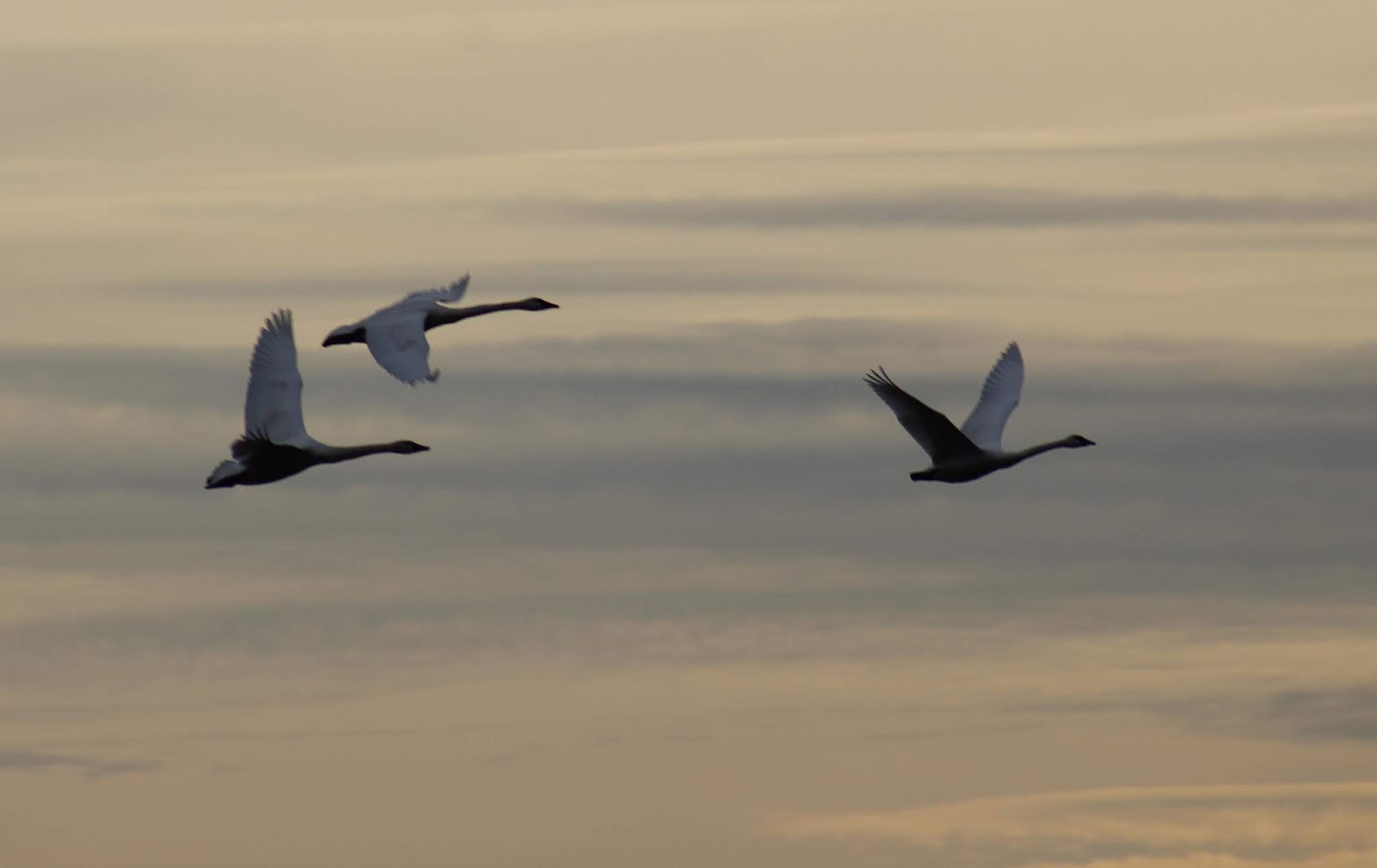
I stopped to scan a few of the Trumpeter Swan flocks, attempting to find some Tundra Swans mixed in, but didn’t find any.

I drove past the “East 90” eBird site on Bayview-Edison Road, and saw there were a couple of photographers out in the WDFW area.

So, I stopped and scoped the fields from the road and saw a Short-eared Owl perched about 50 yards beyond one of the ‘shutterbugs’.
Yes, that's an Owl!
So, I walked out, passing a flock of White-crowned Sparrows and a few Marsh Wrens.  I spent about an hour there, watching not one but two owls coursing across the fields.

There were a couple of Peregrines, as well as the ubiquitous Bald Eagles.
Trees full of Bald Eagles

Finally, I drove over through Edison, a charming little berg along the south side of Samish Bay,

then over to the mouth of the Samish River.  I hadn’t been here for thirty years, and the place was a little more time-worn than I’d remembered.
Samish River mouth

There were a few ‘fixer-uppers’ below the bridge,

A boat is a hole in the water, that you just pour money through . . .

a few heron and swans,

and – of course – views of the ubiquitous Bald Eagles.
"Ubiquitous" means they are everywhere!
I left the flats when I figured that I wouldn’t find any more bird species, but I was wrong:
Jungle Fowl
Then, I headed back to Mount Vernon, arriving at 4 p.m., and waited until Marty was finished with her work at 4:30, then we checked into the Hampton Inn in Burlington, and went to supper at the Sakura restaurant across the parking lot from the motel.  Not a bad supper…

Trumpeter Swan Field eBird Checklist is Here
East 90 eBird Checklist is Here
Samish River mouth eBird Checklist is Here