I went out to the Billy Frank Jr. Nisqually National
Wildlife Refuge today, where 22 birders enjoyed participating in the weekly “Wednesday
Bird Walk”
 |
| Nisqually Birders |
on a cool (low 40°s) morning with high overcast. The “leader of the gaggle”, Refuge Volunteer Phil Kelley, noted
that “the birds cooperated.”
I noted several hundred crows leaving their roost to the
east of the Nisqually River as I drove in.
When I arrived at the Visitors’ Center at 8 a.m., there was a Peregrine
Falcon in the snag-top of a large Douglas Fir tree, and a pair of Hooded
Mergansers joined the Mallards on the pond.
 |
| Lots of Mallards on today's walk |
Our ‘usual’ route proceeds from the Visitors’ Center past
the Environmental Center and into the old Brown’s Farm orchard, which has some ‘legacy’
apple and pear trees. The group
 |
| Refuge Volunteer Shep Thorp Digiscopes a Sapsucker |
had good
views of a Red-breasted Sapsucker, Downy Woodpecker, a couple Anna’s
Hummingbirds, Song, Fox, and Golden-crowned Sparrows, Ruby- and Golden-crowned
Kinglets, and Brown Creepers.
Exiting the orchard, a Red-tailed Hawk posed for the group
 |
| Red-tailed Hawk sittin' on a limb |
As we came around the service road and onto the west side
of the Boardwalk Loop, Anders pointed out a group of 16 Snow Geese that were
flushed by a Bald Eagle, and settled in with the Cackling Geese.
 |
| There were lots of Bald Eagles on the Refuge today, including this scrappy pair of immature birds |
While we were on the boardwalk, a guy came along with a
retriever on a leash. The dog was not
well-behaved, straining against the leash, pulling toward people for a ‘pet’,
and such. We told him that dogs were not
allowed on the Refuge, and he said “This is a “Service Animal”. Dubious, we let him know that his
out-of-control dog was not a Service Animal, and shouldn’t be there, but he had
no shame and bulled his way past us.
The Refuge Volunteers are not Law Enforcement, and -
Bless Their Hearts - are not confrontational.
In fact, most of us Washingtonians are only slightly less
confrontational than Canadians. So, this
jerk took his dog for a walk on a National Wildlife Refuge in flagrant
disregard of the Rules, of the wishes of other Refuge visitors, and the needs of the
Wildlife. There's a special place in Hell for nice people like him . . .
We had ‘brunch’ at the Twin Barns, where a nice spike
buck browsed on Himalaya Blackberry leaves,
 |
| Spike Buck - Black-tailed Deer (Odocoileus hemionus columbianus) |
and an Eastern Gray Squirrel came
up to us, begging for peanuts or whatever.
Obviously, people have been feeding this little moocher.
 |
| Eastern Gray Squirrel - a non-native species here |
Then, we headed out onto the north dike where we observed
the wintering pair of Peregrines on a snag in the restoration area
 |
| The larger bird on the left is the female, her mate above right |
and saw quite
a few Bald Eagles. The eagles are drawn
to the Refuge by the late run of chum salmon in the Nisqually River.
A group of us continued along the north dike, and out to
the gate near the end of the estuary boardwalk as the high tide was
ebbing. The receding water allowed good
views of Least Sandpipers
 |
| Least Sandpipers are more brownish on their backs, and have yellow legs |
and Dunlin,
 |
| Dunlin are such a handsome shorebird! |
and we found a single Western Sandpiper
in the flock. Western Sandpipers can be
common - even abundant - along the Coast, but they are a fairly uncommon
wintering bird at Nisqually.
 |
| Western Sandpiper shows a more light-grey plumage, and has dark legs |
 |
| Of course, if you want really yellow legs, there's always the Greater Yellowlegs Tringa melanoleuca |
We had good studies of the gulls. Ring-billed Gulls fed on green shore crabs close to the boardwalk,
 |
| Ring-billed Gull with Green Shore Crab Hemigrapsus oregonensis |
and the large “pink-footed” gulls allowed us to differentiate the more-or-less “pure”
Glaucous-winged Gulls
 |
| The Glaucous-wings have pale gray backs and primary feather tips of the same pale gray |
from the more-obviously hybrid “Olympic” gulls which are
crosses between the Glaucous-wings and Western Gulls.
 |
| "Olympic Gull" showing dark primaries and darker grey mantle, but with dusky feathering on the head |
This pair of gulls at the Nisqually River overlook showed
a nice “pure” Glaucous-wing on the right, and a bird on the left that we would
probably tally on eBird as a Glaucous-wing, but it shows more of a bit of dusky
in the primaries.
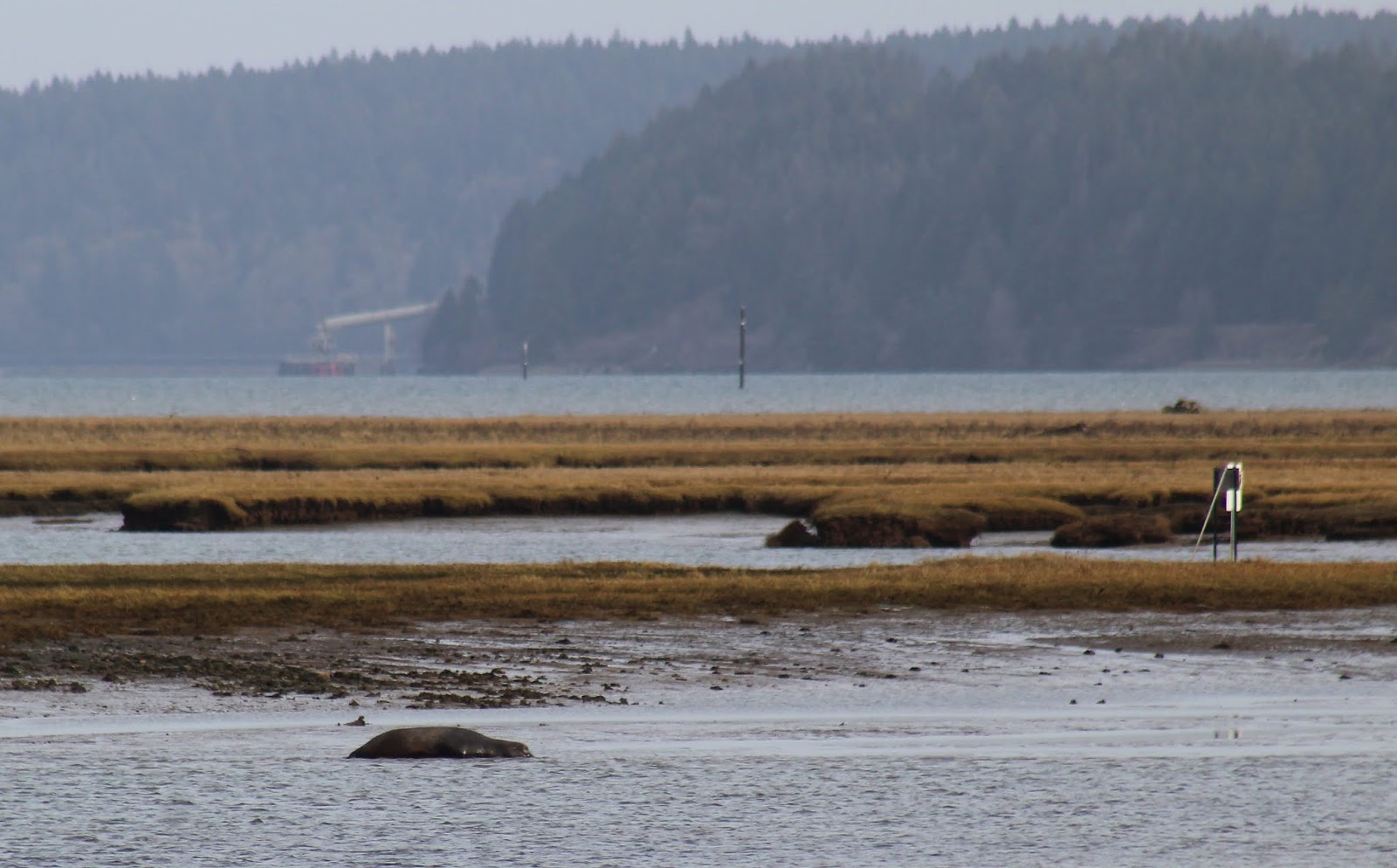
At the north end of the Estuary Boardwalk, we spied a dead California Sea Lion, but it was too far off to know what caused its demise.
 |
| Stranded Sea Lion carcass |
I reported this to the National Oceanic and Atmospheric Administration (NOAA) Stranding Hotline at 1-866-767-6114. The woman who took my information was very professional, but obviously 'not from here', as she was unaware of the location of Nisqually Refuge, etc.
We did not find the Great Horned Owl that had been perched
off the east side of the boardwalk loop for the past three weeks, and it was
fairly quiet bird-wise on our return to the Visitors’ Center. All told, we saw 68 species, and had a pretty
good day, in spite of the cool temperatures.
 |
| Just another Great Blue Heron |
Nisqually eBird Checklist Here