Showing posts with label Bison. Show all posts

Monday, May 27, 2019

May 11 - Fort Niobrara and Valentine NWRs

I was up early, but then forgot that I hadn’t changed the “time” on the computer clocks, so didn’t leave the motel until about 8 a.m.  At least I had a chance to drink 2 cups of coffee.  I drove on out to Fort Niobrara National Wildlife Refuge, stopping at the Visitors’ Center, which was closed for the weekend.
Random bison bones behind the office . . .
I enjoyed the drive around the Auto Tour route though the prairie, seeing the bison and elk.


There were quite a few Grasshopper Sparrows on the Refuge.  I remembered that I’d spent a lot of time back in Washington State looking for them for my year list.  I shouldn’t have worried.
Grasshopper Sparrow - Ammodramus savannarum
Fish and Wildlife has developed a trail to the Niobrara River, allowing one to walk down to the water.
Cool little 'waterfall' along the trail
The trail is well-vegetated, relative to the open country of the prairie drive, and there were the common woodland birds here.
This was a very vocal Least Flycatcher
The House Wrens, of course, kept to their cover
The river through here is included as a National Scenic River.  Only ¼ of 1% of the rivers in our country are so designated.  It looks as though this would be a great place to canoe or kayak.


Leaving the Refuge, I headed south on Highway 83, and drove the Auto Tour route though Valentine National Wildlife Refuge.  This drive goes through the prairies of the sand hills and along several lakes.
This is wonderful Sand Hills prairie
With the usual marsh and prairie birds.
Yellow-headed Blackbird
Male Brown-headed Cowbird
Leaving the Sand Hills, I drove on south on Highways 83 and down Highway 2, then took Highway 92 east to Wahoo.  The town isn’t nearly as exciting as the name implies, but I checked into the Wahoo Heritage Inn for $90.81, and went over to Chip’s for supper.  Eight ounce flat iron steak and 2 beers cost $24.

Fort Niobrara NWR eBird Checklist is Here
Fort Niobrara NWR area eBird Checklist is Here
Fort Falls Trail eBird Checklist is Here
Valentine NWR eBird Checklist is Here

Sunday, May 5, 2019

April 19 - Black-capped Vireo at Wichita Mtns NWR


I went down to eat breakfast at the Windham Microtel here in Altus.  Pretty much just a waffle maker and weak coffee at this motel, and they didn’t open until 6:30.  I got out of the motel by 7:30 and drove east to the Wichita Mountains National Wildlife Refuge around 8:30.  My reason for back-tracking to this Refuge was to see if I could find the Black-capped Vireo, which I'd never seen before & which would move me toward my goal of seeing 75 "Life Birds" this year.

I initially stopped at the small dam below the Visitors’ Center, and viewed the Bison and Longhorn Cattle that are part of this Refuge’s restoration legacy.
These large mammals are free-ranging, and potentially hazardous
My, what big horns you have . . .
There was a flock of Wild Turkeys, with the Tom strutting his stuff.

Perhaps, just a bit ostentatious?

Then, I drove toward the Quanah Parker Lake dam.

There is a monument to this amazing Comanche leader, warrior, and statesman.  If you don’t know the history of Parker and his leadership of the Quahadi band of the Comanche Nation, the Wikipedia entry is a start.  A much better biography is:  Empire of the Summer Moon: Quanah Parker and the Rise and Fall of the Comanches, the Most Powerful Indian Tribe in American History, by S. C. Gwynne.
Quanah Parker photo from the Comanche Nation website
I read the epitaph of Quanah Parker at the Refuge:

Do not stand at my grave and weep
I am not there, I do not sleep.
I am a thousand winds that blow
I am the diamond glint in snow
I am the sunlight on ripened grain.
I am the gentle autumn rain.
When you wake in the morning hush.
I am the swift uplifting rush
of quiet birds in circling flight.
I am the soft starlight at night.
Do not stand at my grave and weep.
I am not there, I do not sleep.
Ai!

I stopped at a little pullout before I got to the dam, as there were a number of birds flitting about.  Most turned out to be Chipping and Lark Sparrows, but there were some Myrtle and Orange-crowned Warblers, and a Black-chinned Hummingbird.
These Lark Sparrows are just such handsome birds!
Blue-gray Gnatcatcher
We don't get Gnatcatchers in Washington State
Hard to see the black chin on this hummingbird . . .
. . . Until he turns around!
Then, I heard the bubbling, buzzy call of the Black-capped Vireo, and waited until he showed himself. 
Yay!  ABA Life Bird No. 599


This species was at the brink of extinction - only around 350 birds remained - when I started birding, due to loss of their required habitat of shrubby oak and ‘cedar’ less than 15 feet high.  These brushlands are often cleared to provide grazing for livestock.

Another major threat to the vireo was the presence of the parasitic Brown-headed Cowbird. Cowbirds lay their eggs in the nests of vireos and other songbirds.  The nesting bird does not recognize the difference between their eggs and cowbird eggs, and incubate all the eggs in the nests.  Cowbird eggs hatch earlier than vireos, and the young are larger than the vireo chicks.  As a result, vireo nests parasitized by cowbirds usually fledge only cowbird young.

The Refuge not only manages their 59,000 acres well, but has also conducted control programs to reduce cowbird numbers, and the Vireo population has recovered from the brink, now standing at around 14,000 birds in the Edwards Plateau in Texas and the populations in west Oklahoma.  This recovery resulted in the species being removed from the Endangered Species list in 2018.  It’s nice to see an ESA success story.  It will, of course, take on-going management to remain a success.
No Longer Endangered
Many of the prairie wildflowers are in bloom here.  I believe that the paintbrush is Castilleja purpurea, which in spite of its species name comes not only in purple (var. purpurea) but also in yellow (var. citrina) and a shade that ranges from orange to red (var. lindheimeri).
Castilleja "citrina"
Castilleja "lindheimeri"
Many other flowers were showing.
Meadow Garlic - Allium canadense
Prairie "Hyacinth" - Camassia angusta
Plains Bee Blossom - Oenothera patriciae (used to be Gaura brachycarpa)
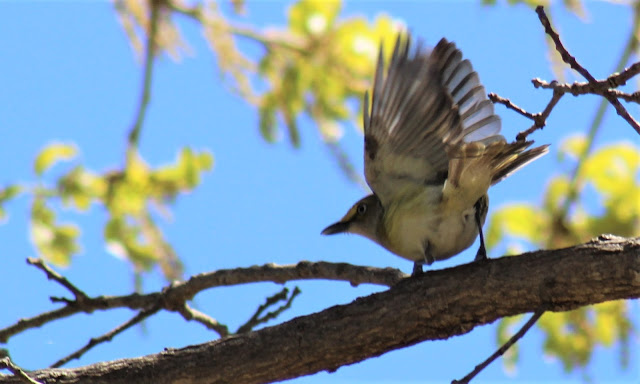
I walked from the dam to the Doris Campground and back, finding another pair of Vireos, and seeing my ‘first-of-the-season’ Summer Tanager, and a pair of White-eyed Vireos.
White-eyed Vireos
This species has white eyes . . . who'd a thought?
I enjoyed talking to the folks who were going to do some ‘bouldering’ near Little Baldy and going to the Narrows rock-climbing area.  At noon, it was time to turn back toward home, so I walked back past the reservoir.
Red-eared Sliders
I drove north on Highway 49 out of the Refuge and headed northwest, seeing my second Western Kingbird of the year near the little burg of Reed, just before I got into Texas.  I ended up staying the night north of Amarillo at the Red Roof Inn in Dumas, Texas.  Supper was at the 287 Roadhouse, where I had a very average sirloin steak and a couple of pints of ZiegenBock Amber - which was pretty good - for $22.  Back at the motel, I was tired and went to bed early.

Wichita Mountains NWR eBird Checklist is Here
Quanah Parker Dam area eBird Checklist is Here
Doris Campground area eBird Checklist is Here
Reed, Oklahoma eBird Checklist is Here

Sunday, April 28, 2019

April 10 - Chickens Dancing

The alarm was set for 3:30 a.m., as this was the morning of the Greater Prairie Chicken viewing trip, through the Lesser Prairie Chicken Festival.  I went down at 4:30 to meet the other 13 birders to go out to the Greater Prairie Chicken lek.  We met Terry Mitchell from Tulsa Audubon behind the Chamber of Commerce building and boarded a 12-passenger van for the ride out to the lek near Grainola.  I ended up in the back seat wedged in-between Jason Lott from Los Alamos and another birder from Massachusetts, pretty well scrunched in, on a morning that started in the 70s ºF.  We rode out to the spot, and settled in to wait for the dawn’s early light.As the gloaming lightened, we began to hear the distinctive calls of the male Greater Prairie Chicken,
then saw 9 male prairie chickens strutting their stuff in a field about 75 yards off the road.
Incoming . . .
Eventually, these birds were joined by a few others, and we watched ten cocks vying for the attention of three hens, who generally seemed bored with the whole dance.
If you've never watched the dance . . .
 . . . you are missing out on a Spectacle of Nature
As recently as the early 1900s, prairie chickens were so abundant in the Great Plains that they were hunted for the market and shipped by the trainload to Chicago and New York City.  A combination of intense hunting pressure and the moldboard plow, which allowed people to convert prairie to farmland more quickly and farm larger areas, led to the decimation of prairie chicken populations.

The most recent estimate that I could find of the greater prairie chicken population in North America is around 400,000.  This is about 10 times the estimated population size of the lesser prairie chicken, but is only a tiny fraction of their historical population size in North America.
Handsome birds!


The van was pretty 'close' and the crowd was getting restless, but we didn't want to spook the birds from their lek.
After about an hour of watching, and after watching farmers stop in the road and make noise, we deemed it safe to turn the van around and watch - more comfortably - from the side away from the lek, still so as to not spook the birds.
Terry is checking the field behind us . . .
We watched for another half-hour.  The field across the road from the lek had been burned recently (since Saturday, when Terry had scouted) and the field the lek was in was short grass.
This hen decided to leave the strutting cocks, and walked through the burnt field
We watched the chickens dance until around 8 a.m. then got into the van for the drive over to the Nature Conservancy’s Tallgrass Prairie Preserve about 12 miles north of Pawhuska.  We birded around the bridge over Sand Creek for a bit, hearing the Field Sparrows call, and seeing several more Louisiana Waterthrushes and a Northern Parula.
Digiscoped . . . I'll get the technique down before the year's over . . .
I was impressed with the beautiful blooming of the Redbud trees.
Redbud - Cercis candensis
Shoals of pink petals
Then, we were planning to do a bit of birding at the Osage Hills State Park, but realized that we didn’t have time to get there, bird-watch, and return to the preserve in time for lunch, so we stopped along a little rill that drained into Sand Creek.  Here, we saw a couple of Black Vultures migrating with the more common Turkey Vultures.

Returning for a catered lunch of fajita makings and ice tea, several of us did a little post-lunch birding.  I was intrigued with the early flowers blooming
I don't know this one.  A Phlox?  Any ID help is appreciated . . .

Rose Vervain - Glandularia canadensis
as well as the herd of Bison on the way out of the Preserve.
 
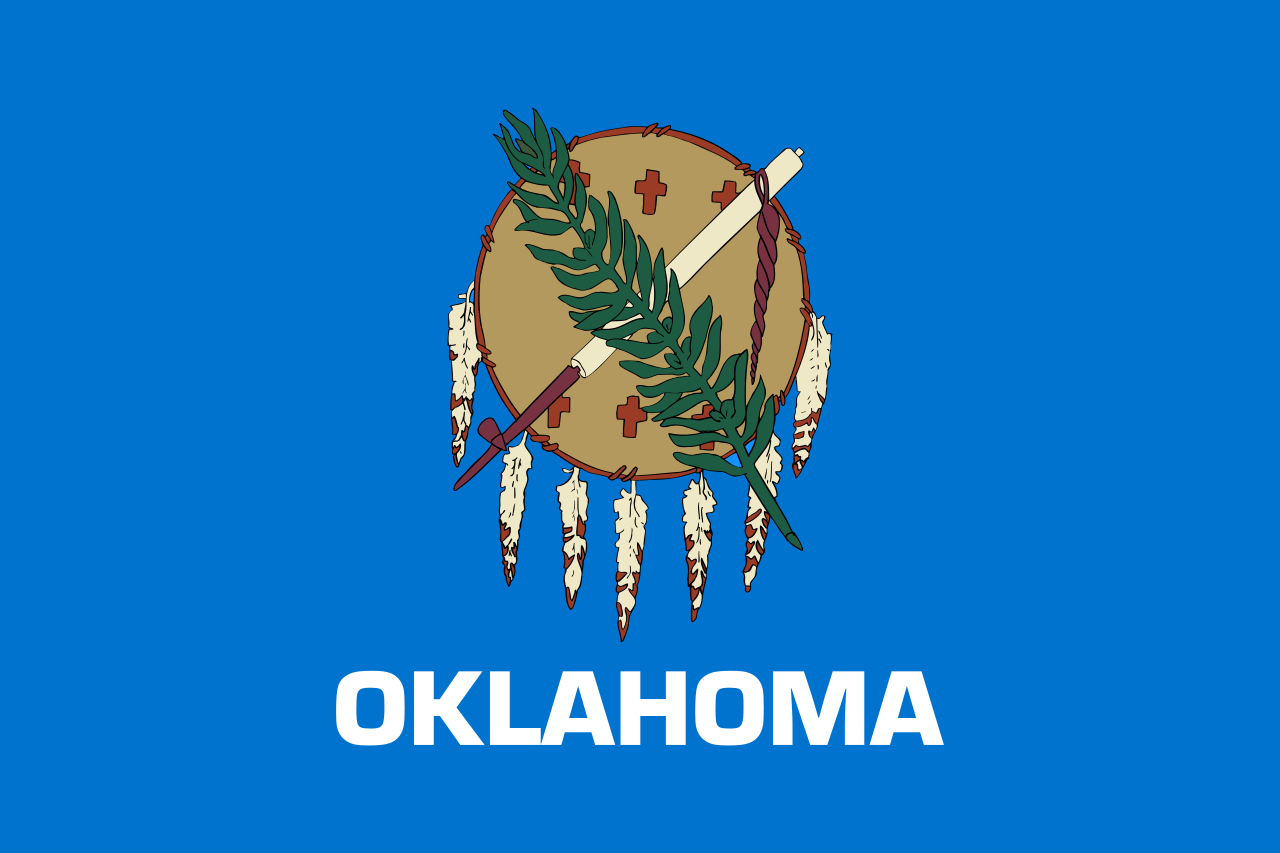
The day was getting toward late afternoon as we returned to Pawhuska.  Some of us went to the Osage Nation Museum, which provides a bit of the Tribal history.  One of the best ‘artifacts’ was the warrior drum of one of the ‘chiefs’ of the tribe, which was used as the model for the Warrior Shield on the Oklahoma State Flag.
Stolen from Tess Maure's Facebook page, 'cause my shot didn't come out
Public Domain, https://commons.wikimedia.org/w/index.php?curid=527607
It had got up to about 85º today, and was pretty breezy as I headed west on Highway 60 to Woodward.  When I arrived, I realized I hadn’t made a reservation for tonight, but there was room at the Northwest Inn, so they checked me in.  I washed up, picked off a couple ticks (I hate ticks!), and headed down for the ‘free’ fish & shrimp dinner, but found out that they closed at 7:30 and I was too late, so I went to my room, drank a beer and went to bed.


Grainola area lek crack-of-dawn eBird Checklist is Here

Grainola area lek morning eBird Checklist is Here
 (Note that the lek is near the pin drop for these 2 checklists, per the request of the landowner and the Festival organizers)

Tallgrass Prairie Preserve eBird Checklist is Here

Sand Creek tributary eBird Checklist is Here

Tallgrass Prairie Preserve HQ eBird Checklist is Here