Showing posts with label Song Sparrow. Show all posts

Monday, February 11, 2019

January 30 - Nisqually Refuge


I got up with the alarm at 5:45 this morning, and went out to Nisqually Refuge for the weekly bird walk.   The skies were clear, but temperatures were just at freezing, and frost highlighted the day.

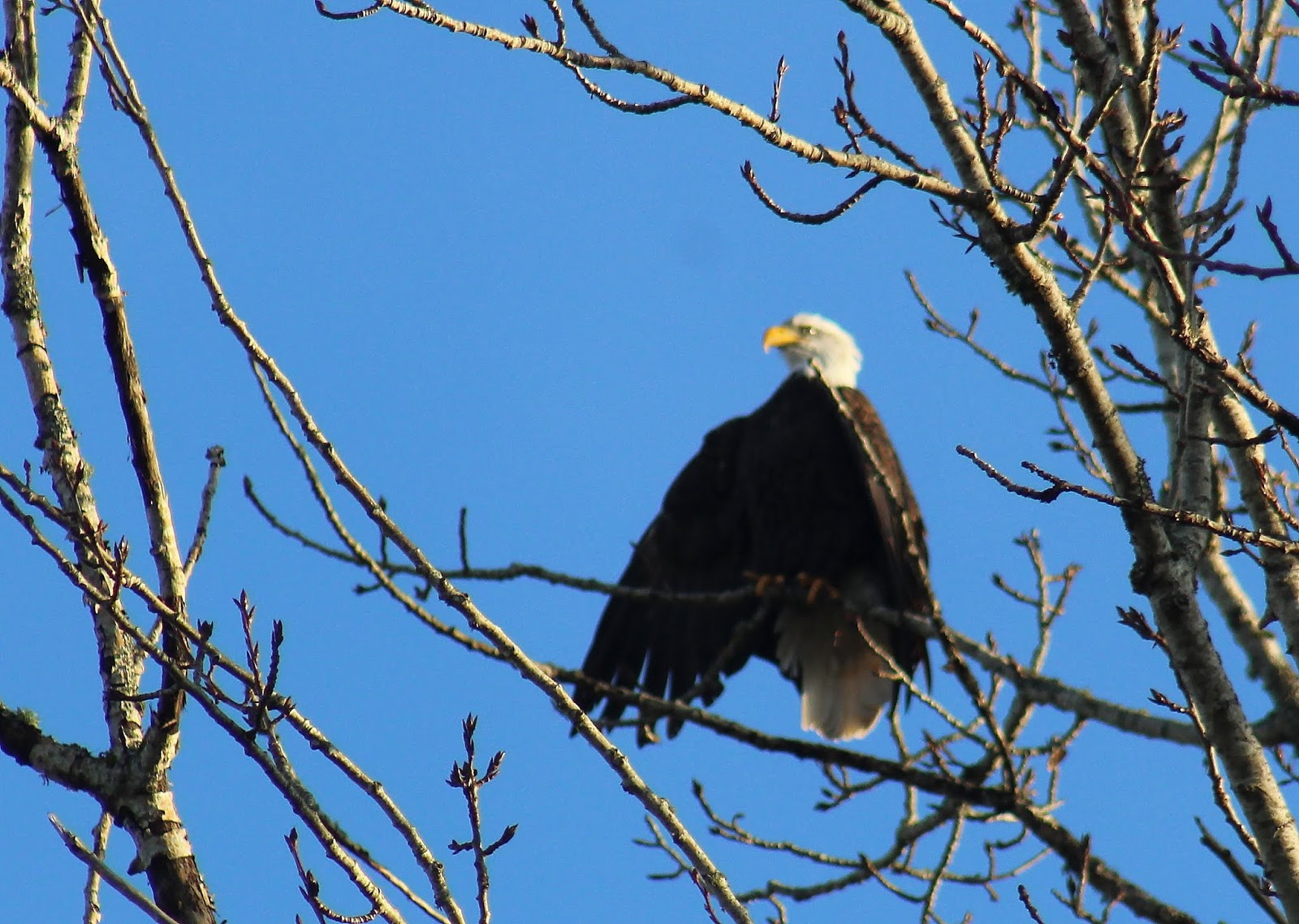
This eagle posed with its wings extended to receive the warming rays of the rising sun

The standard route took us through the heritage orchard, where the group had good views of the resident Red-breasted Sapsucker.

Birders getting "Sapsucker Neck"
Richard "Digiscoping" the sapsucker
I don’t know if frosty weather causes the grasses to put more sugars or proteins into their leaves, but the Golden-crowned Sparrow flock spent quite a while grazing on the roadside grasses.
Grazing Golden-crowned Sparrow
After leaving the orchard, the path leads around a service road, then out along the west side of the boardwalk loop toward the Twin Barns.  Here, we watched a Song Sparrow doing a great imitation of a Nuthatch!
This is just such an odd posture for a Song Sparrow
These conks growing on a willow trunk caught my eye.  This appears to be a species of Polypore Phellinus igniarius.
"Willow Bracket" Phellinus igniarius
The fungus causes a condition known as “white rot” which causes the wood to decay.  Woodpeckers know that these trees will have softer wood in which to burrow nesting holes, or might have subsequent infestations of ants or beetle larvae.

After a snack stop at the Barns, we ventured out onto the north dike, separating the estuary marsh from the remaining freshwater marsh and fields.  Here we have good views of the usual herons and waterfowl
Obligatory Great Blue Heron photo
This Green-winged Teal pair must be going to the Baths to get the mud off their bellies

Northern Pintail drake
Northern Pintail hen
At the base of the estuary boardwalk, we saw a Song Sparrow that was from one of the lighter-plumaged populations.


Shep eBirded it as M.m. montana/merrilli, but we will submit the observation to the Washington Bird Records Committee folks.  It is certainly from a different subspecies than the usual west coast birds, which are more chocolate-colored.

As we went out onto the estuary boardwalk, the fog rolled in

How do you see birds in this?

The fog lifted here and there to reveal birds and seals
But, then it would roll back in.

We did get good views of gulls, waterfowl, and shorebirds
"Olympic Gull" - Glaucous-winged X Western gull
Adult Ring-billed Gull
Eurasian Wigeon drake and an American Wigeon hen
Least Sandpiper - the world's smallest sandpiper
With the high tide, I heard a Refuge visitor say something along the lines of “look at the scum”, presuming that he was seeing a polluted body of water.
Diatoms, not "scum"

In fact, the floating brown ‘scum’ is an accumulation of diatoms, which are single-celled algae which have a cell wall of silica.  These algae blooms provide the primary food base for many of the ‘higher’ animals on the mud flats.


Participants on the walk tend to drop out or move ahead of the volunteer trip leaders, but we had about 8 of the two dozen continue to the Nisqually River overlook,

and back to the Visitors’ Center where we began.
On the way back, we saw a "White Collar" Robin . . .

As we were tallying the day’s sightings, we noticed a Red-eared Slider sunning itself along the pond bank.  These have to be tough critters to be out on a January day that barely made it into the 40s.
Red-eared Slider, Trachemys scripta, is a non-native exotic species
The End
 Nisqually eBird Checklist is Here

Thursday, January 17, 2019

January 15 - Hawks Prairie Settling Ponds

This afternoon, I drove out to the Hawks Prairie Settling Ponds.
Mount Rainier with its head in the clouds
At this 40 acre site, operated by the LOTT (Lacey-Olympia-Tumwater-Thurston County) Clean Water Alliance on Hogum Bay Road in Lacey, Class A Reclaimed Water circulates through a series of five constructed wetland ponds.
Gadwalls and a Ring-necked Duck
Water from the ponds then flows to rectangular groundwater recharge basins.  From there, the water infiltrates through the soils to replenish groundwater.  The site is open to the public and features walking trails, viewing benches, wildlife, native plantings, and kiosks with information about reclaimed water.

The north side of the site used to be an open field, with grasses and some Scotch Broom, and bordered by second-growth Douglas fir woods.  Then, a year ago, there began construction and development of the properties to the north of the LOTT facility.
Construction in January 2018

Now, the north ponds butt up against a road and stark walls of warehouses.
January 2019
The many acres of industrial buildings will likely provide an increased tax base for the City of Lacey, but is part of the on-going loss of open space and wildlife habitat in south Puget Sound.


These forty acres at the settling ponds are a bit louder now with the current construction, and increased semi-trailer traffic, but still provide an oasis for wildlife and the public.  Because the water comes into the facility with quite a bit of nutrient load, there is good growth of aquatic plants.  This time of year, the American Wigeon and Gadwalls feed extensively on the duckweed growing at the ponds’ surfaces.
It's called "Duckweed" for a reason . . . .
The LOTT folks have planted the site with “native plants”.  The original prairie soils at the site may not be the most appropriate for Sitka Spruce, which tend to thrive along the alluvial and wetland soils of riparian sites.
Sitka Spruce needles and cones

Growing on less than optimal sites result in the trees becoming stressed during the dry season and such.  And, the stressed trees are consequently more susceptible to being impacted by diseases and insects.
These are NOT cones . . .
These “cones” are actually the galls of the Cooley spruce gall adelgid, Adelges cooleyi.  These “woolly aphids” are a small family (Adelgidae) of true bugs (Hemiptera) closely related to the aphids. Overwintering females on spruce lay eggs near developing buds. Nymphs hatch as bud caps split. Nymphs feed at the base of developing buds in spring producing cone-like galls on the tips of blue spruce branches. Galls open in mid-summer. Emerging adelgids either continue to live on spruce or fly to Douglas-fir to lay eggs. On Douglas-fir they may continue to live or produce a generation that flies back to spruce to produce the gall-forming stage. On Douglas-fir, feeding on needles by nymphs produces yellow spots and curled needles but no galls.

The Douglas firs here provide perches for many birds, including Bald Eagles,
Adult Bald Eagle
who would enjoy lunching on waterfowl
Green-winged Teal drake
However, many of the firs around here have either died, or have dead tops, likely a result of the Laminated Root Rot caused by the fungal pathogen Phellinus weirii.  Laminated root rot is one of the most damaging root diseases amongst conifers in northwestern America.
Stress kills . . .
The conifers are not the only trees here impacted by bugs and disease.  The Pacific madrona is native along the coast from British Columbia to California.
Young madrona - the Canadians call them "Arbutus"

Many of the madronas here have a leaf blight, consisting of brown, desiccated leaves occurring mainly in the lower canopy.
Madrona Foliar Blight - the ugly brown spots

This foliar blight has been observed on Pacific Madrona throughout its range and generally occurs during periods of wet spring weather.  In May 2009 and 2011 severe outbreaks occurred in western Washington and Oregon.  A fungus was isolated from blighted foliage, leaf spots on emerging foliage, lesions on green shoots, and from the petiole and leaf blade of dead, attached leaves.  The fungus was identical to the type isolate of Phacidiopycnis washingtonensis, which has been reported to cause rots of stored apple and persimmon fruit and cankers and twig dieback of apple and crabapple trees, but had not been reported on other plant species.
Leaf miners write in their own language
The ‘ghost scrawl’ on some of these leaves is caused by the Serpentine madrona miner (Marmara arbutiella), which is a tiny species of moth.  Larvae of this leaf- and twig-mining moth blaze sinuous, serpentine mines across the surface of leaves. Although damage might be unsightly on individual leaves, they do not usually affect the long-term health of the tree. This moth affects madrona throughout its range.

But, all was not disease and infestation, and I enjoyed seeing the usual birds, including this Song Sparrow
Song Sparrow on Common Cattail head
and a flock of Bushtits
Female Bushtits have yellow eyes,
and the males have dark eyes
Hawks Prairie SP eBird Checklist is Here