
I was awake again at 4:30; any more, it seems to be the time for me to rise in whichever time zone I’m in. I worked a bit on my Blog entries from last August (Only 3 months behind, then!).

Afterwards, I walked around the hotel grounds in the dawning day, watching the trains go by, reading the town history, and marveling at the “Burning Man” art.

I’d stayed in Room Number 3 last night, which was the room Clara Bow took when she stayed at the Hotel.

The hotel itself was called the Nipton Hotel until sometime recently, and was established as a stop on the Union Pacific line between LA and Las Vegas.
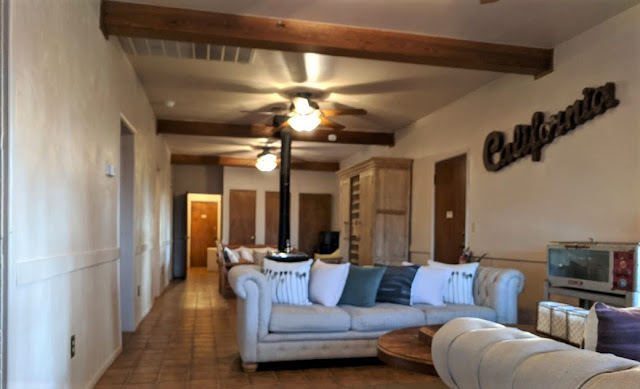

The interior of the hotel has maintained its 1920s feel and charm. Not a bad place, and only around $75 for the night's stay.

The trains no longer stop, but still go by a dozen or so times a day, and the first train in the morning will likely waken you. The hotel supplies ear plugs alongside the usual soaps and shampoos.

The woman behind the counter at the Trading Post told me that the entire village is owned by CannAwake, an energy development/real estate/cannabis company that bought the town in 2017 and are fixing it up, running the Hotel, restaurant and campgrounds, and puting in a local brewery.

There were a few birds in the area, most evidently a pair of young Cooper’s Hawks hunting amongst the eucalyptus.

From town, one can see the Ivanpah Solar Energy plant, built by Bechtel for Houston-based NRG Energy to sell power to Pacific Gas and Electric Company and Southern California Edison. Federal biologists estimate about 6,000 birds die from collisions or immolation annually while chasing flying insects around the facility's towers. This is apparently an acceptable loss of wildlife for America to develop “Clean Energy” . . .

I left town around 7:30, and made a quick stop at the Valley Wells Rest Area, where I was greeted by a friendly pair of ravens. They showed less interest as I came and went with little prospect of their bumming a morning snack.

There were a number of Joshua trees, the largest of the yuccas, here. This yucca grows only in the Mojave Desert. Its height varies from 15-40 feet with a diameter of 1-3 feet. They grow 2 to 3 inches a year, takes 50 to 60 years to mature, and they can live 150 years.

I stopped at Baker, California, where I ate breakfast at the Mad Greek Café, then drove to Death Valley National Park and used my Senior Pass in lieu of the $30 entrance fee. Too bad that the United States can’t have free admission to its National Parks and Museums, as do more civilized countries such as Great Britain.

Death Valley has a long history, from Native Americans to the immigrants to the present day.

Nowadays, rather than the 49ers suffering on their way to the gold fields, our current tourists willingly subject themselves to the rigors of the desert.

At the Visitors’ Center, I watched the NPS movie about the Park, and checked out the Furnace Springs golf course’s water ditch, looking for a few birds.

A flight of Dragonflies reflected the abundance of life, anywhere in the desert where there’s water.

I left the center, glad that I’d gassed up back along the Interstate in Baker!

Driving up to the Salt Creek wetland boardwalk and hoping to view the Desert Pupfish, I never could get a photo of them, but the little 1.5-centimeter critters were common enough in the salty stream.

Iodine Bush Allenrolfea occidentalis and saltgrass Distichlis spicata were the main components of the ‘riparian’ area.

These plants are phreatophytes, meaning the species can tolerate the elevated soil salinity, sending their roots to the ground water interface.

The only birds I saw there were a single croaking raven on the hillside, and a Pipit along the bank.

There were a few other visitors on the boardwalk, but I pretty much had the place to myself. I had never before been in this desert, and quite enjoyed my chance to learn about it and its flora & fauna.

I stopped for a fry bread taco lunch at the Timbisha Shoshone’s café on their reservation. The Tribe was just recently Federally-recognized in 1984. And, after 90 years of being ignored or bullied by the Park Service on the land that they’ve lived on for 1,000 years, they had the land at their Furnace Creek home restored to them in 2000.

I finished my visit to the Park by driving down to Badwater, the lowest elevation in the United States at 282 feet below sea level.

There was quite the crowd at the boardwalk, and I heard more non-English languages spoken there than ‘Merican. I also had to stop a Park Ranger’s truck and let them know that along the road, I’d stopped to chew out a couple carloads of city-slicks who were throwing rocks at a coyote. The poor thing was trying to retrieve its prey, and the touristas were aghast that the coyote had killed a living creature!!! They yelled at me and brandished rocks when I told them that harassing wildlife was illegal in the park . . .

I got a sour taste of humanity, but thought about it for a bit and realized that I’d really enjoyed my day here, and there was no reason to let a moment of others’ actions move me from my own “Center”. I left the park, heading west, and ended up staying the night at A Nights Inn in Ridgecrest, with the intent to make some miles toward home tomorrow.

Nipton eBird Checklist Here
Valley Wells Rest Area eBird Checklist is Here
Death Valley - Furnace Creek eBird Checklist is Here
Death Valley - Salt Creek Trail eBird Checklist is Here
Death Valley - Badwater eBird Checklist is Here


