It was 30°
and overcast when we got up, and I went out to Nisqually after seeing Marty off
to work. The Refuge volunteers lead a
bird walk every Wednesday, meeting at the Visitors’ Center at 8 a.m., and I try to get out there when I'm in town. The walk is structured so that participants can
leave any time, and there are breaks where the morning group slowly melts away
until a half-dozen “intrepid” (crazy?) birders complete the entire 5-to-6 mile
walk. It’s all level ground, so not
strenuous.
Two dozen
birders followed the ‘usual’ route through the Heritage orchard, along the
service road and boardwalk to the Twin Barns, then out the north dike to the
estuary boardwalk.
Today,
besides the birds, the Wednesday walkers were treated to quite a number of
mammalian wildlife, including deer,
 |
| Columbian Black-tailed Deer |
coyote,
 |
| This song dog paid little attention to the birders |
raccoon,
 |
| So shy . . . |
and mink among others.
 |
| American Mink Neovison vison (I liked the old name: Mustela vision) |
 |
| After crossing the log, he rubbed his scent glands all over the willows |
Sometimes,
there were bird-mammal interactions . . .
 |
| Great Blue Heron captures a Vole (Microtus sp.) |
 |
| Re-arranges . . . |
 |
| Positions . . . |
 |
| Aaannd - - - Swallows! |
as well as
bird-fish interactions. The birds always
seem to come out the better in these exchanges.
 |
| Double-crested Cormorant caught a Starry Flounder |
We watched,
rather than photographed, a Peregrine make a serious attempt at catching a
Green-winged Teal, but she missed, and the teal got away having only lost a big
tuft of feathers. Sometimes, you just
have to revel in the event, instead of attempting to document it.
 |
| Elizabeth reveling in the moment |
But, there
are always birds to be seen.
 |
| Mew Gull Larus canus |
 |
| Greater Yellowlegs Tringa melanoleuca |
 |
| Canada Goose Branta canadensis |
 |
| Male Belted Kingfisher Megaceryle alcyon |
 |
| Curious pose for a Song Sparrow |
Below, Volunteer
leader Shep Thorp checks out one of the two Bald Eagle nests on the west bank of
McAllister Creek. One nest is visible
through scopes from the south end of the estuary boardwalk, and the other from
near the north end.
One nest is visible
through scopes from the south end of the estuary boardwalk, and the other from
near the north end.
 |
| Also, from the end of the boardwalk, you can see the Luhr Beach WDFW facility |
The walk
usually passes by the Nisqually River overlook on the return to the starting
point. Here, a Glaucous-winged Gull
rested on a cottonwood drift log.
Although
both Barn and Great Horned Owls have been seen in recent weeks, we did not see
either species today. I was intrigued by
a male Mallard - as told by his yellow, rather than orange and black bill -
that seemed to either have retained immature plumage, or might have a hormone
issue and showed ‘female’ feathering?
 |
| Starting to get some color in his head . . . |
 |
| Most Mallard drakes are in full alternate plumage this time of year |
Back at the
beginning, we found that the Visitors’ Center pond held several surprises among
the usual suspects.
A pair of
Wilson’s Snipe lounged in the afternoon sun,
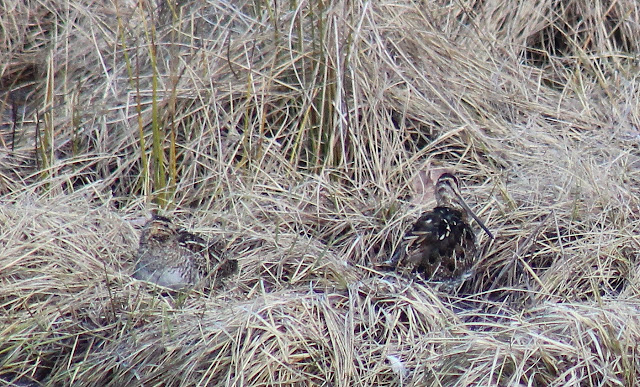 |
| Good place for a "Snipe Hunt" |
as did a
large Red-eared Slider.
 |
| Not native to Washington, but always fun to see |
Nisqually
NWR eBird Checklist is Here


