It was 44º F and foggy when I took my CrossTrek to Tumwater Automotive at 8:30 for maintenance. Since I had a while before the auto work would be finished, I had the rest of the morning to do some birding.

I walked down Capitol Boulevard toward Tumwater Falls Park, and as I got even with the historical Carlyon Bridge on “Old 99”, I heard a Black Phoebe vocalizing from near the river. I finally got a view of the bird, but it stayed behind the alder limbs and I didn’t have the opportunity to get a photo before it quit calling and foraging, and I lost sight of it.

The Black Phoebe is a fairly recent addition to Washington’s avifauna, with the first “official” record coming in 1980 over at the Coast in Moclips. Since then, the species has expanded its range north from its ‘stronghold’ in California and southern Oregon to the point it was dropped from the “Review List” of the Washington Bird Records Committee in 2011. A pair of these Phoebes was regularly seen at the nearby Hawks Prairie settling ponds from 2011 to 2018, and was suspected of breeding there.

I let a few of the Olympia birders know about the Phoebe, and birded my way through Tumwater Falls and Tumwater Heritage parks, and along Capitol Lake to downtown Olympia.
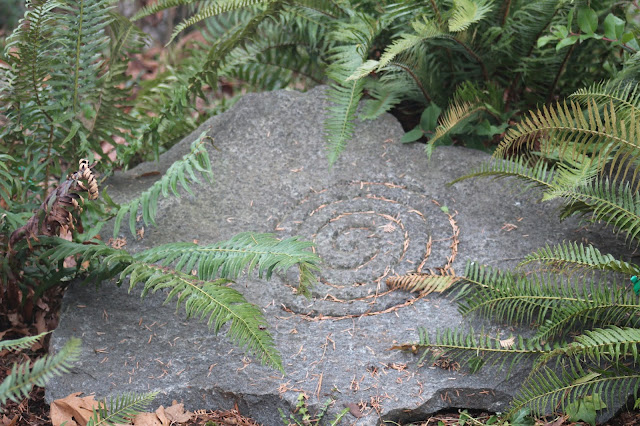
The Olympia Tumwater Foundation has developed a Native Plant Garden at Tumwater Falls Park in association with the local tribes. Along with the plants, there is representation of ‘aboriginal art’.

There’s a “culture” of couples who place a padlock on fences, tree branches, etc. to proclaim their love for one another. An off-the-main-trail spot at the upper falls at Tumwater Falls Park is festooned with dozens (hundreds?) of these locks. I can only wish them all the best and hope that the Love expressed here has lasted as long as some of the hardware. Of course, there are always those who Don’t See The Love . . .

One of the reasons that Tumwater Falls attracts birders is that it is one of the easiest places around to “twitch” an American Dipper. The birds nest near or underneath waterfalls, building moss nests that are constantly damp, but they seem to fare well here. The birds wade along the water’s edge, and often surprise new birders by swimming out into the current or just stepping underwater to hunt their prey of aquatic insects, fish eggs, and the like.

As I walked along the path above the Deschutes River, I noticed an odd shape floating in the water and presumed it was a piece of trash washed in from upstream.

Closer inspection, though, revealed that it was a cup-shaped ball of foam. Foam is a natural phenomenon that occurs on many streams, produced when molecules such as fatty acids act as 'surfactants', interfering with the surface tension of water and allowing air and water to mix more easily. These molecules often float on the surface of the water as a thin film. The action of the waterfall froths the organics in the water, producing the foam. This can be a natural event with no adverse environmental implications; alternatively this can be a sign of pollution and high phosphorous levels. In any event, it was a curious effect.

Traversing from the Tumwater Falls Park to the City of Lacey’s Tumwater Historical Park, you pass by the “Old Olympia Brewhouse”, which is in the process of being renovated.

This structure was built in 1906, but had deteriorated pretty badly.


The city park has a large “lawn” area that attracts grazing waterfowl, including these Canada Geese. A migrant Cackling Goose had joined the resident flock.

The trail continues north along the “middle pool” of the former estuary, often called “South Capitol Lake”. Here, there is riparian vegetation, willows, red alders, and some planted conifers (yes, I’m aware that alders have cones . . .) adjacent to the “lake”, so it’s a great place to see a variety of waterfowl and songbirds.


This autumn, there has been a fairly sizeable flock of Canvasbacks on the lake.

These are among our largest diving ducks, and are distinctive among waterfowl breeding in North America with the profile of their head sloping upward from tip of long bill to the back of the crown.

Both diving ducks and “dabbling ducks” are common along this stretch of the trail. Here are three Northern Pintails, a hen American Wigeon, and a pair of Gadwalls. Although one of the Pintails appears to be significantly more drab than the brightly-plumaged adult males, it is not a hen, but rather a male; an immature bird just moulting into its first pre-alternate plumage.

The main walkway is paved; there is a ‘side loop’ that sometimes serves as access to homeless campsites. I have never been bothered by these unfortunate folks, but some birders feel uncomfortable birding the ‘back trail’. There are often some nice birds tucked away along the west side of the loop.

I had to go into downtown Olympia for an errand or two, and was glad that I wasn’t driving. One never knows when the Citizenry of the town/State will join together to express their opinions and wishes for the betterment of Society . . .

Finishing, I caught the IT Bus back to Tumwater to pick up my car, and on the way home, I saw Ken Brown near the entrance to the Valley, searching for the Black Phoebe, and stopped to see whether he'd been successful. He had not seen the phoebe, but we had a flock of White-fronted Geese fly up the river to land at the golf course.

Finally, I arrived home to read in a recent Capital Press that the U.S. Fish and Wildlife
Service has proposed to “delist” the Bradshaw’s Desert Parsley Lomatium
bradshawii from the list of Endangered Species. Endemic to and once widespread in the wet,
open areas of the Willamette Valley of western Oregon, Bradshaw's Lomatium is
limited now to a few sites in Lane, Marion, and Benton Counties. Most of its
habitat has been destroyed by land development for agriculture, industry, and
housing. There had been a few of these
Endangered plants in the wet prairies on Ankeny NWR when I worked there back in the 1970s-80s, but the USFWS (who
listed the damned thing species) partnered with Ducks Unlimited to ‘develop’ “Eagle Marsh” as a waterfowl pond, and wiped out the only spot in the area that I’d
ever seen the species. Follow-up: This plant was “delisted” from ESA-Endangered on March 7, 2021.
Tumwater Falls Park eBird
checklist is Here
Tumwater Historical Park eBird checklist is Here
South Capitol Lake Trail eBird checklist is Here
Capitol Lake eBird checklist is Here
Tumwater Valley eBird checklist is Here


