“Pishing” is the “psss-psss-psssh” noise that birders make, especially in the wintertime, to attempt to draw a skulking bird out of cover for a view. The sound imitates a distress call, and sparrows, chickadees and finches, especially, are likely to respond.

This technique is thought to work due to its similarity to the scold calls of chickadees and “tits”, which is what the birds do when mobbing a predator, attracting other birds which come in to check out the potential threat.

I’d taken time off from birding for the past week or so - Christmas with family and out-of-town friends, followed by a “stomach bug” kept me close to home.

Finally getting out on Saint John’s Day Friday, I headed toward the Washington Coast, hoping to find something “exciting”. My first stop was at the mouth of Perry Creek, a tributary of Puget Sound’s Eld Inlet, just west of Olympia.

There is a run of fall chum salmon into the creek every year. The chum population in Eld Inlet averages 52,000 adults in odd-numbers years like this, and 50,000 in even years, with most spawning taking place in McLane, Swift and Perry creeks. Pacific Salmon are anadromous (migratory) and semelparous (die after spawning), and the gulls and eagles take advantage of this abundance of protein to help get through the winter.

Even weeks after the fish have gone to the “Big School In The Sky”, their carcasses provide foraging to a good number of birds.

People would expect eagles and gulls to tear into the piscine larder, but are surprised that waterfowl will also take part in the feast. There were a number of mergansers, Hooded and Common, feeding in the stream on dead fish and washed-out eggs of the salmon. These species have serrated bills to hold onto prey, and are often called “fish ducks”.

It surprises people that other ducks will also feed on fish. The Mallard is often considered a prime species for the table: When it is feeding on corn! Here in the Pacific Northwest, Mallards will often congregate at salmon spawning streams to feed, like the gulls, on rotten salmon carcasses. In these circumstances, their flesh tastes pretty much like what they are feeding on . . .

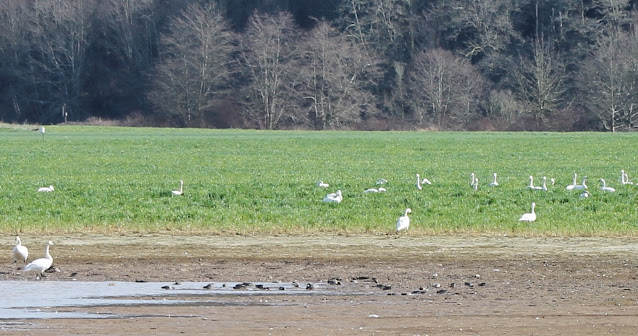
I made a quick swing along the Wenzel Slough Road, looping off of State Highway 12 along the Chehalis River bottom south of Elma, checking out the Trumpeter Swan flock.
My next stop was at the Westport Marina, where I spent time sorting through the flock of 800 Marbled Godwits, hoping to suss out a rarity.

When the tide is right, and the California Sea Lions aren’t monopolizing the old docks, the Godwits use the floats as a roosting spot, giving birders good views.

Neither the “Coast Guard floats” nor the finger jetties had any unusual birds, but it is always interesting to watch the fishing boats come in. Here, the Lady Nancy, a 42-foot crabber built in 1979, returns to harbor.

The recent weather and high tides had flooded some of the town’s streets with salt water.

I go out of my way to avoid driving through salt - salt water, salt water beaches, or States that salt the roads for snow and ice. With that in mind, I own a 1989 Corolla with 200K miles and not a spot of rust!

Another birding “hotspot” is down in Pacific County, where the little marina at Tokeland provides habitat for birds and easy access to birders. On the way through “town”, I noticed a flock of Dusky Canada Geese.

This subspecies nests on Alaska’s Copper River Delta, and winters along the Washington and Oregon coasts, as well as along the lower Columbia River and Willamette Valley. The population was heavily impacted by the 1964 Earthquake that raised the Delta, draining it which resulted in shrubs and trees growing in former marshland. Then, predators moved into the former marsh, and significantly reduced survival of this unique race of birds.

On the floats and shoreline at the Tokeland Marina were more Godwits, and mixed into the flock were a number of Willets. This is one of the few places in the Pacific Northwest where a birder can expect to find this species during the winter. I saw nothing ‘new’ for me for the year, and am reconciled to that fact. It’d be nice to pick up another species or two for the year, but without travelling, the likelihood is low.

On the way out of the marina area, I saw some Greater White-fronted Geese grazing near the RV Park. These geese are referred to as “Speckle-bellies” by the waterfowl hunters, due to the dark splotching on their undersides. As you can see in the photo, the adults have a white patch of feathers at the base of their bills, while the immature bird has none.

UH . . .

No, I’m not necessarily confused. I was surprised to also find a pair of Black Brant grazing in the grassy parking area. The “classic” view of these birds is them feeding on eel grass in the bays or in Puget Sound. One of the birds sported a plastic neck collar which read “UH”. The Alaska Science Center marked this bird along the Colville River as an adult female during a study of the survival and distribution of Brant. Whenever one is able to read an ‘auxiliary marker’ such as a plastic neck collar, a patagial (wing) tag, or a leg band, it should be reported to the U.S. Geological Survey’s Bird Banding Lab.

On Saturday, I had some errands to do around town so got little birding in, except what I did while walking downtown from my west OlyWA home. While going over my species list on Sunday, I was provided with a challenge: I realized that during all my travels this year, I had - somehow - not “twitched” a Rusty Blackbird! A female of the species had recently been seen up at the Kai Tai Lagoon Park in Port Townsend.

So, I made the two-hour drive to Port Townsend to look the Blackbird. The Park was created around a former pocket estuary that was ‘orphaned’ during port development in the 1960s.

I had no success with the species, but met a few other birders there. One was Monica, for whom the blackbird would have been a “Lifer”, and the other was a gentleman named Richard, who was there with his mother Anne. We all “dipped” on seeing the wayward blackbird, but I believe we were all happy to be in the outdoors on this overcast (but not raining) day.

With no trace of the blackbird, I thought about giving the Lagoon a rest, and drove up to the Fort Worden State Park to check out the beaches and scope the waters off of Point Wilson. And, I always like seeing the lighthouse here. It’s showing a bit of wear, and one would hope that the Coast Guard could put a little effort into upkeep.

One of the great things about this area is the views of the Cascades Mountains:
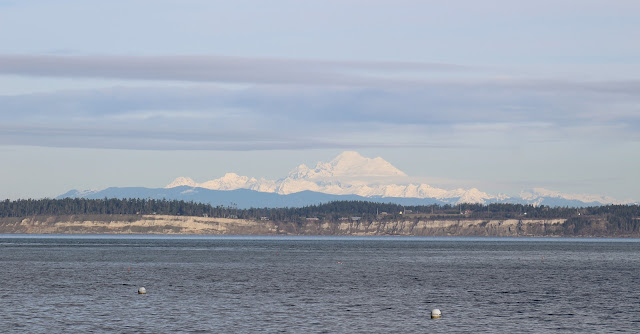


There is a good view of Admiralty Inlet and the eastern Strait of Juan de Fuca from Fort Warden State Park, and the dock at the Marine Science Center. The Center and its aquarium is a great little natural history museum, and well worth visiting if you’re in the area.

I didn’t see much exciting, other than a nice Black Oystercatcher hunting the rocks at the tide line. Whereas the American Oystercatcher is usually found on sandy beaches and mud flats, our Black species is almost always found on rocks or rocky shorelines.

I finally went back to Kai Tai Park, walking from the Kearney Street parking lot to the west end of the lake, but was again unsuccessful at finding the blackbird. There were a lot of gulls returning to the lagoon for their evening’s roost, and I picked an immature Thayer’s Gull from the bunch. There was also a young Cooper’s Hawk hunting the area, and I hoped that she hadn’t had the Blackbird for lunch. I continued birding until dark, and it was time to head home. No new species for the year. . .

It was Monday the 30th, and I’m running out of time to find much in the way of ‘new’ species for my Peregrination year. One of the birds I did miss was the Pine Grosbeak. We often pick them up on our winter trip to the Okanogan Highlands, but missed them this year. With local options for finding another species diminishing, and time Slip-slidin’ away, I decided to head into the Cascades to see if I might find one of the wayward Grosbeaks up at White Pass. There was a bit of snow at the Pass, and I didn’t have equipment to ski or snowshoe around the loop trail at Leech Lake, so I just walked up to the Nordic Center & back, finding a family of Gray Jays. (This species has since been re-named “Canada Jay” by the Ornithologists’ Society)

It was really quiet up here, for birds, so I decided to drop down to the trailhead for the Sand Ridge trail in Yakima County, and walk up to the Wilderness Area. The area is named after William O. Douglas: an American jurist and politician who served as an associate justice of the Supreme Court of the United States, and who was known for his strong progressive views, and is often cited as the Supreme Court's most liberal justice ever. The 1984 Washington Wilderness Act designated the Cougar Lake Roadless area as the William O. Douglas Wilderness.

Again: the woods were very still, and I only found a pair of Hairy Woodpeckers and heard a Nuthatch. With dusk descending on the mountain, I headed back toward home. No ‘new’ species, but a day well-spent in the Cascades.

Dec 27th:
Perry Creek eBird checklist is Here
Wenzel Slough eBird checklist is Here
Westport Marina eBird Checklist is Here
Brady’s Oysters eBird Checklist is Here
Tokeland Marina eBird Checklist is Here

Dec 28th:
West OlyWA eBird Checklist is Here
West Bay eBird Checklist is Here

Dec 29th:
Kai Tai Lagoon a.m. eBird Checklist is Here
Marine Science Center eBird Checklist is Here
Point Wilson Light eBird Checklist is Here
Kai Tai Lagoon p.m. eBird Checklist is Here

Dec 30th:
White Pass eBird Checklist is Here
Sand Ridge Trail eBird Checklist is Here


