Friday, April 10, 2020

September 9-12, 2019 - The Pribilofs - Birding Saint Paul Island


Saint Paul Village
Our WINGS guides, and half of the birders were stranded on Saint Lawrence Island on Saturday, due to the weather, and so didn’t make the Sunday flight out to the Pribilofs.
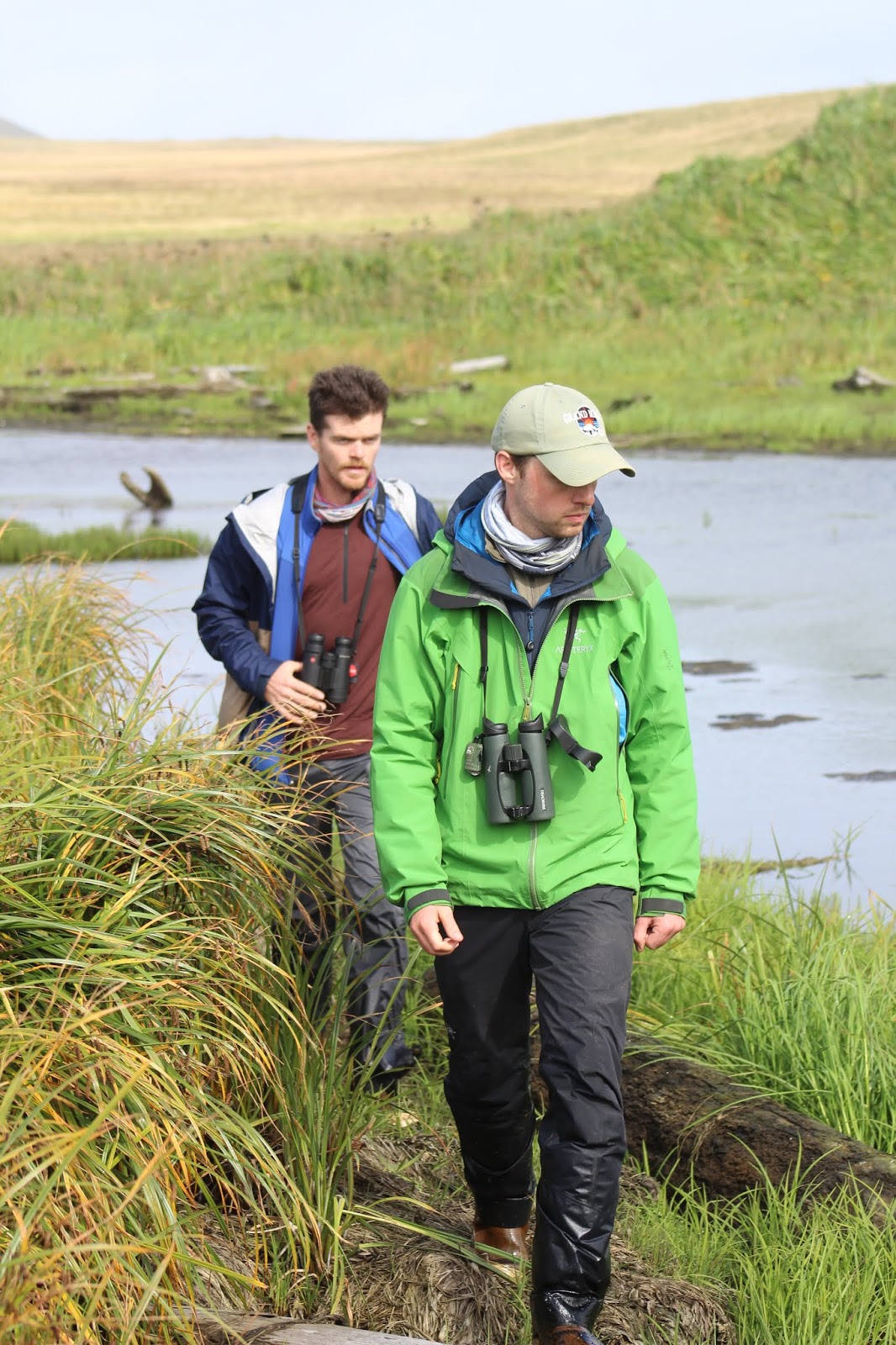
Luckily, WINGS had made arrangements for the ‘local’ guides to lead us on this amazing tour.  Our tour leaders were Sulli Gibson, Alex Harper, and Marc Kramer from Saint Paul Island Tour, which is fully owned by TDX Corporation, the Alaska Native Corporation.
Our Guides:  Marc, Sulli, and Alex
We five "tourists" had the guides and the birding to ourselves all day Monday.

Then, on the afternoon of Tuesday the 10th, the remainder of the WINGS birders arrived on a belated plane.  They’d had to stay over at Gambell, then made it to Anchorage, where they birded for a couple of days prior to making it to the Pribilofs.  The plane-load included Dave and Tammy McQuade, who are doing their third Birding Big Year in a row!  Our WINGS tour leaders could not make the plane, as it was full, so we birders all got to finish the tour with Sulli, Alex, and Marc.
 
Our birding days start with our waking at the King Eider Hotel.  I was usually up early enough to make a pot of coffee for us caffeine addicts.
Then, we got picked up and taken to breakfast at the Trident Seafoods' cafeteria at daybreak.

Trident has a fish processing plant on the island.  In the summer, they process halibut and employ about 30 people.  The big season is in the winter during crab season when the factory employs 300 seasonal employees.  This is the only “restaurant” on the island, and draws customers from the fish plant employees, the locals, and we visiting birders.  The food is cafeteria style, and reflects the diets of us “Anglos”, as well as some interesting Asian and Filipino cuisine.
It's not just the location, it's the ambience . . .
Then we’d load into vans to check out birding locations around the island.  On the way out of “town”, we’d often stop at the Salt Lagoon and English Bay, where depending on the tide, we could view the mudflats for shorebirds.
Here is a Pacific Golden Plover hunting for its breakfast of polychaete worms.
On Monday, we’d made an effort to re-locate a Jack Snipe that had been seen in the Zapadni slough east of Antone Lake last week, and started to get a feel for the lay of the land on the island.
When the “Gambell crew” arrived we tried again, to no avail.
What?  No Snipe?
The Jack Snipe has a reputation of holding very tight to its cover, and often flushing right at your feet.

Walking narrow transects through the wetland proved unsuccessful.
After several attempts, I recommended possibly dragging a rope through (actually, over) the marsh vegetation, as that technique can flush a bird without injuring it or frightening it too much.

When the rope just rode up over the sedges, we tried weighting it down a bit with some fishing floats that we’d found washed up on the beach.


But, still, we didn’t flush the snipe for the group, although the guides really worked to find it for us.
 
The guides had re-found the bird a couple of times, just not when the birders were present.  So, we filed into the slough again and again.

We did see other ‘shorebirds’ in the slough, including phalaropes and my “Lifer” Sharp-tailed Sandpiper.  This had been a “nemesis bird” for me for years, and I was pleased to finally have seen one; the first of several on the island.
Sharp-tailed Sandpiper
Finally, on Wednesday afternoon, we made yet another attempt, walking our tight transects through the area the bird had been seen earlier.
Then Alex and Sulli tried expanding the search area a bit, and we were rewarded with the bird flushing and flying a short way, landing again at the edge of some sedges.
Finally the snipe flushed again, giving the entire group a view of this tiny snipe with bold, golden mantle stripes, white trailing edges to the secondaries, light underwings, and a short bill.This was a Life Bird for many of us, my 856th “World Life Bird” and 653rd in the ABA Area.  My photo was pretty ‘fuzzy’ but Tammy McQuade got an identifiable shot.
My crappy shot of a Life Bird - the Jack Snipe!
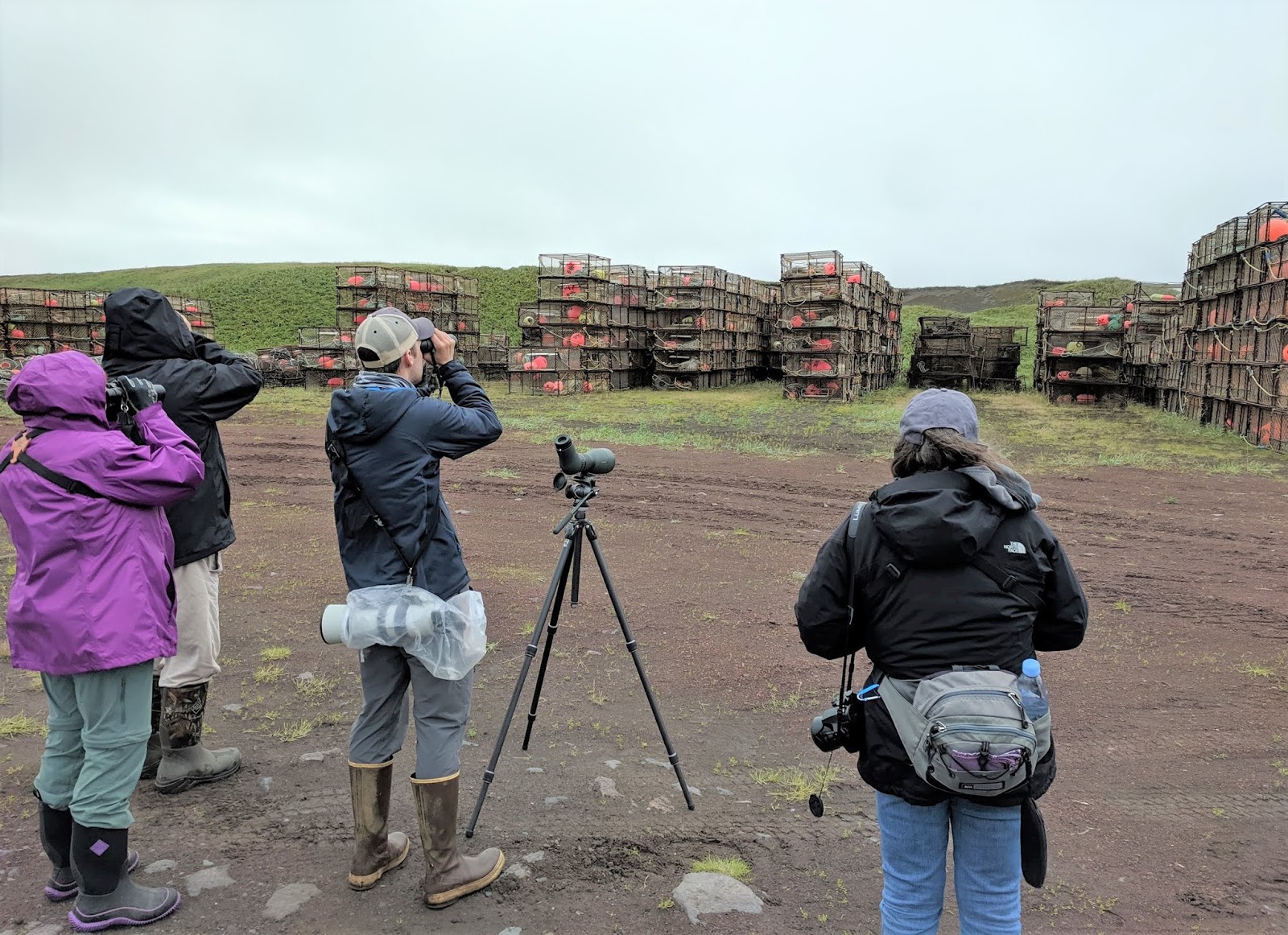
One of the spots we check daily is the large line of stacked metal crab pots (more like big cages) that are used during the winter months to catch Dungeness crab.

Since there are no trees on the island, the pots serve as a surrogate forest for birds.
The ‘protocol’ for birding the pots is that most of the group would take positions to look into and along the rows of traps.
A birder or two would go around to the back, while one of the guides would pass in-between the rows of pots, tapping a stick, and hoping that a bird would pop out into the open to see what was up with all the commotion!
We’d usually see the local endemic subspecies of Pribilof Gray-crowned Rosy Finches and Common Redpolls here.
Pribilof Gray-crowned Rosy Finch
Common Redpoll
Snow Buntings are also seen in the quarry areas.  The Buntings nesting on the Pribilofs, Aleutian and Commander Islands are of the Plectrophenax nivalis townsendi subspecies.
Hiding amongst the rocks . . .
Another “regular” stop was to view the seabird nesting cliffs at Marunich and at Southwest Point.

From the south side of the island, you can see Otter Island, about 8 miles to the southwest.
In the spring, the cliffs of Saint Paul Island are filled with nesting seabirds.
Of course, there are fewer birds remaining in September
Among the “target” species for birders are the Red-legged Kittiwakes.  Over  90% of the world’s population of this species nests in these islands.
Red-legged Kittiwake on left, two Black-leggeds at right
After breeding has been completed, most individuals move offshore of the islands, but small numbers remain present through September.
Immature Red-legged Kittiwake
This is a pretty rare bird south of these northern waters.  Prior to this trip, I’d only seen a single Red-legged off the Oregon Coast on a repositioning cruise.

The Black-legged Kittiwake is more familiar to most of us birders.  These are also common nesting birds here on the islands.
The Kittiwakes were not restricted to the cliffs, as we would see them almost wherever there was water.  Here, a flock of both species takes off from Pumphouse Lake.
Northern Fulmars are an abundant breeding bird on the islands.  Most of the Fulmars on these cliffs have the pale gray plumage which I’m used to seeing only a few of while on pelagic birding trips out of Westport, Washington.
There were a few of the darker gray color morphs flying about.
In the Fulmar populations of the Pacific, light-plumaged birds tend to predominate to the north, and dark-plumaged birds to the south.
Bering Sea colonies have few dark morphs (0 - 0.2%), whereas Fulmars breeding in the Aleutians are mostly dark morphs (99%), and the gulf of Alaska and B.C. colonies are 75-85% dark.
This is the opposite of what occurs in the Atlantic populations, where the dark-morph birds are more southerly and the light-phase birds more northerly in distribution.
Interestingly, a 2015 paper by Kerr and Dove recommends that the amount of genetic difference between the Pacific and Atlantic birds warrants elevating the Pacific population to a separate species.
Here at the seabird cliffs, also, I “twitched” other “Life” Birds, including the Thick-billed Murre.
This murre differs from the Common Murre by having a bit heavier bill, and having a white line at the gape of the bill, which the Commons lack.
The Red-faced Cormorant is another Pribilofs specialty, and was a “Lifer” for me.
These birds have thicker necks than the similar-sized Pelagic Cormorants, but their thicker necks reminded me a lot of Brandt’s Cormorants, which are common nesters on the West Coast of the US.  The red faces of these birds as we saw them in September is muted from what I’d expect during the Spring nesting season.
And Puffins!!  East Coast birders wishing to see our Left Coast Tufted Puffin have a few places, such as at Haystack Rock in Oregon, where they are regularly seen.


Here, it was fun to see them sharing the cliffs with the Horned Puffins.
The Horned Puffin is a relatively difficult bird to see along the Pacific Northwest coast.

The Washington Bird Records Committee only removed the species from its “Review List” in 2013.
I believe that, had I had more time on the island, I would have spent a lot more time at the seabird cliffs.
I would love to be here in the Springtime!
Along the Oregon and Washington Coast, we birders tend to go to the jetties and headlands and sort through the Surfbirds and Black Turnstones to find Rock Sandpipers.  But we don’t see this nominate subspecies of this “rockpiper”.
The nesting birds here on the Pribilofs, as well as on St. Matthew Island, tend to winter there and south to the Alaskan Peninsula.  The Pribilof population is distinctive in its larger size and lighter-gray plumage.  The Aleutian and Mainland subspecies are pretty similar to each other.
Rock Sandpiper feeding in the wrack
The Pribilof Rock Sandpiper was considered to be its own species until it, and the other Rock Sandpiper subspecies were ‘lumped’ with the Purple Sandpiper in the 1910 American Ornithological Union Checklist.  Then, in 1931 the AOU split the Purple from the “Rock” Sandpipers, leaving the “Pribilof Sandpiper” with its current cousin subspecies.

Several times, we would go to the Northeast Point of the Island, where we could overlook the Vostochni fur seal rookery.

This is the only place we found Glaucous Gulls
There are a number of towers at each of the rookeries that are used to count the seals and aid in the various research projects conducted by NMFS and the USFWS.
At the Northeast Point, just south of Webster Lake, there’s a ‘cabin’ with a Russian Orthodox style “gazebo” built near it.

We rested on a bench that was propped up with the vertebra of a whale!
We walked the putchki here several times, seeing mostly Lapland Longspurs.
Walking through this habitat is harder than it looks . . .


There was a single Sooty Fox Sparrow here as well, the only one we saw on this trip.
Away atop Hutchinson Hill, there’s a rock cairn surmounted by a granite monument, with a sweeping view of the Bering Sea.
It turns out it is a grave stone, with an inscription that reads:
James Heath

Gunners Mate

1st Class

USS Concord

Born 1864

Died 1894

According to Fredericka Martin in Before the Storm: A Year in the Pribilof Islands, while the U.S.S. Concord was patrolling during the days of pelagic seal hunting, Seaman Heath had contracted pyæmia (blood poisoning) and died.  The Russian Orthodox priest, a Father Rezanoff, read his church’s funeral liturgy as Heath was buried in the sands of Cross Hill.  The next day however, his shipmates dug him up and reburied him on the nearby rocky vista where he now forever resides, setting up a crude wooden marker.  Local tradition ascribes the “new” stone and inscription as a token of the Unangan (Aleut) workmen’s craftsmanship and respect.
We did get to find or chase several rarities besides the Jack Snipe.  Near Marunich, we lucked into seeing a Common Snipe.
I was in the van following the folks in the lead vehicle, who radioed that they had the bird resting near a mud puddle in the road just in front of them.
We backed up and quietly got out at a distance so as not to flush the bird, and ensure that everyone got a view.

This Eurasian bird was considered by ornithologists to be a separate species from the North American Wilson’s Snipe until the 1931 AOU Checklist, when the two forms were lumped.
The Common Snipe has a horkin' large bill . . .

. . . and bright "braces" on its back
Their decision lasted until 2002, when the taxonomists again considered them as two distinct species.
Blurry shot of the Common Snipe as it flies away
The Eurasian bird certainly has a longer bill and more distinct “braces” on its back than does our Wilson’s Snipe.
Wilson's Snipe at Nisqually NWR, Washington on 1 November 2017
Here at Marunich, we also got to see a passing White Wagtail, which we were told was only the 5th fall record for the Pribilofs.  Sulli and I followed the Wagtail toward the dunes at North Beach, when we heard the two-note call of a Grey-tailed Tattler.  We didn’t re-find the Wagtail, but were treated to great views of the Tattler.
Gray-tailed Tattler
In this area as well, the group found a Skylark, but I had lagged behind and was quite a ways back when I heard Sulli yell “Skylark!”  I saw the bird as it flushed in the company of several longspurs; it was clearly different to the longspurs in flight style, and had what appeared to be longer, more slender wings. But, I couldn't independently identify it, so didn’t count it as part of my Year List.  I’d seen this species in England, as an “introduced” population when they still populated San Juan Island in Washington State, as well as in its remaining population on Vancouver Island.  And, it’s common as an introduced species in New Zealand, but I have not seen a “wild” Skylark in North America.  Ah well… next time!

However, I did see a number of “Life Species” for my American Birding Association area (Canada and the U.S.) list.  My goal for this Peregrination year was to increase my Life List by 75 species.  The first new species as I arrived on Saint Paul Island was the Red-faced Cormorant, which was my 75th “Lifer” for the year!!  Everything from this point on is Gravy!
Pribilof Rock Sandpiper
As it was, I picked up seven Lifers on Saint Paul:  The cormorant, Red-necked Stint, Thick-billed Murre, Gray-tailed Tattler, Sharp-tailed Sandpiper, and the Jack and Common Snipes.
Pacific Golden Plover
But, the best part of the trip was to be able to visit one of the iconic and exotic remote birding destinations of North America.  It is my first visit to Alaska, and to be able to go birding here, to sample the culture of the Unangan people, and to meet and bird with some of the top birders in the country made for one memorable tour.

Saint Paul eBird Checklist for 9 September is Here
Saint Paul eBird Checklist for the morning of 10 September is Here
Saint Paul eBird Checklist for the afternoon of 10 September is Here
Saint Paul eBird Checklist for 11 September is Here
Saint Paul eBird Checklist for 12 September is Here


Tuesday, March 31, 2020

Lukannon

For those of us who think of Mowgli, Bagheera, Balo, and Shere Khan from the Disney movie the Jungle Book, or vaguely remember Akela and the "Law of the Pack" from our Cub Scout days, it comes as a surprise that there's a book about the Fur Seals of the Pribilofs in Rudyard Kipling's 1894 classic.


It is called the "White Seal".  Kotick, a rare white-furred fur seal, sees seals being killed by islanders in the Bering Sea.  He decides to find a safe home for his people, and after several years of searching as he comes of age, eventually finds a suitable place.  He returns home and persuades the other seals to follow him.


In each of Rudyard Kipling’s Jungle Book stories, he added a poem as an epilogue.  This is what he appended to the great deep-sea song that all the St. Paul seals sing when they are heading back to their beaches in the summer.  It is indeed a “sort of very sad seal National Anthem.”

Lukannon 

    I met my mates in the morning (and, oh, but I am old!)
    Where roaring on the ledges the summer ground-swell rolled. 
    I heard them lift the chorus that drowned the breakers' song - 
    The Beaches of Lukannon - two million voices strong.


    The song of pleasant stations beside the salt lagoons,
    The song of blowing squadrons that shuffled down the dunes,
    The song of midnight dances that churned the sea to flame -
    The Beaches of Lukannon - before the sealers came!

    I met my mates in the morning (I'll never meet them more!);
    They came and went in legions that darkened all the shore.
    And o'er the foam-flecked offing as far as voice could reach
    We hailed the landing-parties and we sang them up the beach.

    The Beaches of Lukannon--the winter wheat so tall -
    The dripping, crinkled lichens, and the sea-fog drenching all!
    The platforms of our playground, all shining smooth and worn!
    The Beaches of Lukannon - the home where we were born!

    I met my mates in the morning, a broken, scattered band.
    Men shoot us in the water and club us on the land;
    Men drive us to the Salt House like silly sheep and tame,
    And still we sing Lukannon - before the sealers came.

    Wheel down, wheel down to southward - oh, Gooverooska, go!
    And tell the Deep-Sea Viceroys the story of our woe;
    Ere, empty as the shark's egg the tempest flings ashore;
    The Beaches of Lukannon shall know their sons no more!

Rudyard Kipling in “The White Seal”
The Jungle Book, 1894